Chengdu First-Timer's Guide: Pandas, Tea Houses & a 4-Day Itinerary (2026)
Chengdu is not what you think.
You come for the pandas. Every first-timer does. The Research Base delivers — chubby black-and-white bears munching bamboo with the focus of a coder at 2 AM. It is genuinely wonderful.
But what travelers actually remember, three months later, is something else entirely. It is sitting by a lake in People’s Park with a 15 RMB cup of jasmine tea, watching old men play mahjong under hundred-year-old sycamores. It is stumbling across the Matchmaking Corner on a Sunday morning and realizing those parents are posting their adult children’s marriage resumes — age, income, height, zodiac sign — often without their children’s knowledge. It is walking past a 1,600-year-old Buddhist temple and seeing a glass Apple Store directly next door, and understanding that this contrast is not a contradiction. It IS Chengdu.
This is a city of 21 million people that somehow preserved a culture of leisure that Beijing and Shanghai long ago bulldozed. A city that permits slowness in a country that never stops. The pandas are the hook. The tea house is the memory. Do both.
Why Chengdu? The Vibe in One Honest Paragraph
Most Chinese megacities wear their ambition on their sleeve. Beijing has power. Shanghai has money. Shenzhen has speed. Chengdu has… tea.
The “slow life” (慢生活) is a Chengdu cliche, and like most cliches, it is both true and misleading. True: you CAN sit in a bamboo chair by a park lake for four hours with a single cup of tea that costs $2, and not a single person will rush you. This is genuinely rare. Misleading: Chengdu is also a booming metropolis growing by 600,000 people a year, with two international airports, a sprawling tech sector, and skyscrapers that would look at home in Singapore. The teahouse and the skyscraper coexist on the same block. That is the point.
The traveler discovers something unexpected here: a city that built modernity without erasing itself. The mahjong tables stayed. The ear-cleaning vendors stayed. The tea houses — some over a century old — stayed. You can spend your morning at a panda base and your afternoon in a temple courtyard where the only sound is a monk sweeping leaves. Chengdu didn’t choose between the future and the past. It kept both.
Before You Go — Chengdu-Specific Prep
Chengdu is not as demanding as Chongqing (no 8D navigation, no endless stairs), but it has its own quirks. These six tasks separate a smooth trip from a frustrating one.
| Task | Why |
|---|---|
| Set up Alipay before arriving | Chengdu is aggressively cashless. Even street noodle stalls expect a QR scan. Full setup guide |
| Install Amap (高德地图) + VPN | Google Maps is unreliable in China. VPN for Gmail, Instagram, WhatsApp — install and test BEFORE you leave home. |
| Book panda base tickets in advance | Tickets are online-only. The Research Base sells out, especially on weekends and holidays. Book 3–7 days ahead. |
| Pack for overcast weather | Chengdu is famously grey. Locals joke: “Dogs bark when they see the sun.” The basin geography traps clouds. Bring layers, not shorts. |
| Bring digestive aids | Sichuan peppercorn (the ma in mala) creates a numbing, electric sensation that surprises even spice-tolerant travelers. Your stomach will adapt, but day one can be rough. |
| Verify which airport | Chengdu has TWO. Shuangliu (CTU) is closer (~40 min to downtown). Tianfu (TFU) is 1–1.5 hours out. Mixing them up is a common and costly mistake. Confirm your terminal before booking any ground transport. |
Getting There
Chengdu is the gateway to western China — and it is well-connected. The Chengdu + Chongqing combo (1 hour apart by train) is the most popular traveler pairing in southwest China.
| From | Method | Time | Cost (¥) | Cost ($) |
|---|---|---|---|---|
| Chongqing | High-speed rail | ~1 hr | ¥100–150 | $14–21 |
| Xi’an | High-speed rail | ~3.5 hrs | ¥263 | $37 |
| Beijing | Flight recommended | ~3 hrs flight | ¥800–1,500 | $112–210 |
| Shanghai | Flight recommended | ~3 hrs flight | ¥800–1,500 | $112–210 |
| Kunming | High-speed rail | ~6 hrs | ¥300–400 | $42–56 |
If you have the time, pair Chengdu with Chongqing. One hour apart for $14. The contrast — Chengdu’s calm teahouses and pandas versus Chongqing’s neon chaos and stairs — makes both cities better. Read our high-speed rail guide for booking instructions, and our Chongqing first-timer’s guide for the other half of the combo.
Where to Stay
Your neighborhood choice shapes your trip. Chengdu’s core is compact, but each area has a distinct personality.
| Area | Vibe | Price/Night (¥) |
|---|---|---|
| Chunxi Road / Taikoo Li | Dead center. Modern, luxury shopping, walk to everything. The 1,600-year-old Daci Temple sits directly next to a glass Apple Store. This contrast is not staged — it is real Chengdu. | ¥400–1,200 |
| Kuanzhai Alley area | Tourist-centric. Qing-era courtyard architecture. Convenient but busy — street noise can be an issue in courtyard hotels. | ¥300–800 |
| Near People’s Park | Best for culture immersion. Walk to Heming Tea House before the crowds. Mid-range. Quieter at night than Chunxi. | ¥250–600 |
| Jinli / Wuhou Shrine area | Historic neighborhood feel. Good for first-timers who want atmosphere over convenience. Slightly removed from the metro network. | ¥300–700 |
Recommendation for first-timers: People’s Park area. You are 10 minutes from the tea house, 15 minutes from Kuanzhai Alley, and two metro stops from Chunxi Road. The mornings — waking up and walking to the park before the tour groups arrive — are worth the trade-off in luxury. If you prefer modern convenience, Chunxi Road / Taikoo Li puts you at the center of everything.
Convert at approximately ¥1 = $0.14 USD. A ¥400 room is about $56. A ¥800 mid-range room is about $112.
Day 1: The Pandas & The Future
Pandas in the morning. Modernity in the afternoon. This is the day that delivers what you came for — and then surprises you with what Chengdu became.
Morning — Panda Base: The Critical Details
Arrive by 7:30 AM. This is non-negotiable.
Pandas eat and play from roughly 8:00 AM to 10:30 AM. By 10:00 AM, most are sprawled across tree branches, asleep. By 11:00 AM, the tour buses have arrived and the pandas have clocked out. Arrive at 9:00 AM and you have missed the show. Every seasoned traveler says the same thing: I wish I had arrived earlier.
Which base? For first-timers, the Chengdu Research Base of Giant Panda Breeding is the answer. It is closest to the city (30 minutes by taxi), has the most pandas, and houses the superstar Hua Hua at the Juvenile Panda Villa. For a quieter, more intimate experience, Dujiangyan Panda Valley is an excellent alternative — fewer pandas, but also fewer people, and red pandas roam freely. Read our panda base comparison guide for a full breakdown.
Critical details:
- Tickets: ¥55 ($7.70) adult. Book online-only via the official WeChat mini-program or Trip.com. Book 3–7 days ahead.
- Enter through the WEST Gate (西门), not the South Gate. The West Gate is newer, less known, and has dramatically shorter queues. Multiple 2026 traveler reports describe walking straight in while the South Gate had snaking lines.
- Sightseeing bus: ¥30 ($4.20). Buy it. The base is enormous (100+ hectares). Walking everything will exhaust you before you see many pandas.
- Temperature matters: Above 26°C (79°F), pandas retreat to air-conditioned indoor enclosures. Visit in cooler months (March–May, October–November) for the best outdoor viewing.
- Best route from West Gate: Xingxing Nursery (cubs) → Panda Tower (panoramic views) → Sun Nursery → Red Panda Area → Moon Nursery → exit. 2.5–3 hours covers the highlights.
Read our full panda and spice guide for more on the panda experience and what to expect.
Lunch: Zhong Dumplings
Return to the city. Find zhong shuijiao (钟水饺) — Chengdu-style pork dumplings in sweet soy sauce and chili oil, unlike any dumpling you have had in northern China. ¥15–25 per portion. The original shop near Wuhou Shrine is the classic, but any branch with a queue at lunchtime is good.
Afternoon — Chunxi Road & Taikoo Li: The Trend Golden Triangle
After lunch, walk the Chunxi Road / Taikoo Li area. This is Chengdu’s “Trend Golden Triangle” — and it produces some of the city’s most memorable images.
Key moments:
The giant panda climbing up the IFS skyscraper — a massive sculpture scaling the glass facade. It has become Chengdu’s unofficial mascot and the most-photographed piece of public art in the city. Look up. You cannot miss it.
Then walk two minutes to Daci Temple (大慈寺). This is a functioning 1,600-year-old Buddhist temple. Incense burns. Monks chant. And directly outside the temple gate — a glass Apple Store. This contrast is not gimmicky. It is the most Chengdu thing you will see all day. Take a photo through the temple gate framing the Apple logo. It sounds absurd. It works.
The area also features massive 3D naked-eye LED screens — curved displays on building exteriors showing holographic pandas and futuristic animations. It is gaudy and spectacular and free.
Evening — Sichuan Opera or Riverside Bars
Option A: Sichuan Opera at Shufeng Yayun (蜀风雅韵)
Located inside Chengdu Culture Park, this is the classic Sichuan opera experience. The show runs approximately 90 minutes with two evening performances (typically 6:00 PM and 8:00 PM — confirm times when booking). The lineup includes face-changing (变脸) — performers swap masks instantly with a flick of the head — plus fire-breathing, acrobatics, hand shadow puppetry, and folk music. Face-changing alone is worth the price.
- Price: Approximately ¥180 ($25) for standard seats. VIP seats run ¥250–300 ($35–42) and include front-center placement plus tea and snacks. The close-up view of face-changing from VIP seats is genuinely worth the upgrade.
- Rating: 4.7/5 from approximately 7,800+ reviews across platforms.
- Book ahead — shows frequently sell out.
- Arrive 30 minutes early. Tea is served at your bamboo table before the show begins.
Option B: Jiuyanqiao Bar Street
Not into performances? Walk to Jiuyanqiao (九眼桥) — the bar street along the Jinjiang River. The illuminated Anshun Bridge reflected in the water is one of Chengdu’s best night photo spots. Riverside bars, craft beer, live music. More local than expat, though that is changing.
Day 1 totals: ~18,000–20,000 steps. You saw pandas, walked through a 1,600-year-old temple next to a glass Apple Store, and watched a man change his face 12 times in two minutes. Not a bad start.
Day 2: The Real Chengdu — Tea, Mahjong, & The Park
This is the day travelers remember. Day 1 was the postcard. Day 2 is the soul.
Morning — People’s Park: The Best Thing in Chengdu
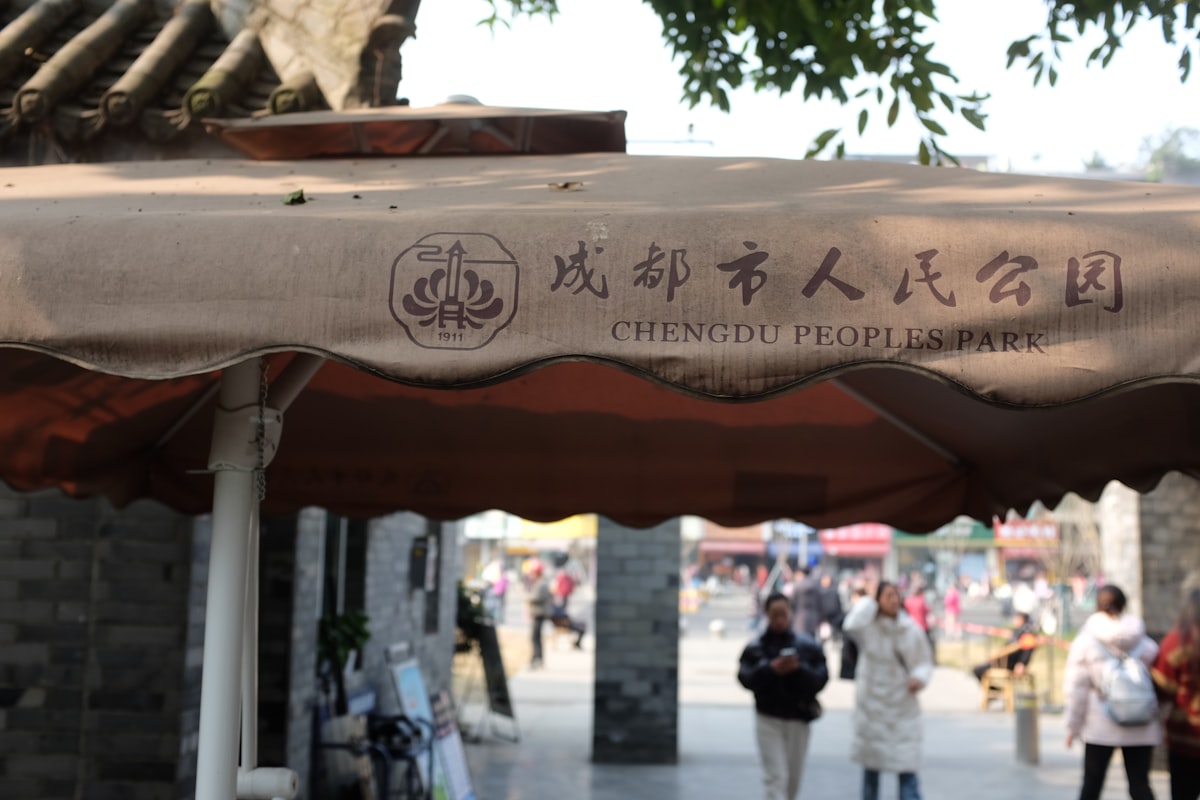
People’s Park (人民公园) is free to enter. It opens early. Go at 8:30 AM, before the crowds, and you will see the park waking up — tai chi practitioners in the bonsai garden, early mahjong tables claiming the best spots under the sycamores, the tea house staff setting out bamboo chairs.
Walk past the bonsai garden. Follow the path toward the lake. Find Heming Tea House (鹤鸣茶社), founded in 1923. This is not a tourist replica. It is a century-old Chengdu institution that has survived wars, revolutions, and skyscraper booms.
Order a gaiwan jasmine tea (盖碗茉莉花茶). ¥15 ($2.10). It arrives in a lidded bowl on a saucer. Unlimited hot water refills. You can sit for four hours. Nobody will rush you. Nobody will even look at you. This is the Chengdu that survived.
What you will see around you:
- Mahjong tables under sycamore trees. The clatter of tiles hitting the table is what locals call “Chengdu’s background music.” Renting a mahjong set costs about ¥15 per hour. Watch a few rounds. The pace is leisurely, the stakes tiny (¥1–5 per point). This is not gambling. It is social glue.
- Ear-cleaning service (采耳) — ¥30 ($4.20). A uniquely Chengdu tradition. Practitioners use long metal tools — tiny scoops, vibrating tuning forks — to clean your ears. It looks alarming. It is surprisingly, deeply relaxing. Locals swear by it. Watch someone else go first if you are unsure.
- Long-spout teapot pouring. The tea masters put on a show — copper pots with meter-long spouts, poured from impossible angles into your cup without spilling a drop. A performance and a refill in one motion.
- The Matchmaking Corner (相亲角). Walk to the northwest section of the park, especially on weekends. Here, parents hang their children’s marriage resumes on strings. Blue paper for men. Pink paper for women. Age, income, height, education, zodiac sign, property ownership — all listed in neat columns, often without the children’s knowledge or consent. The parents network, negotiate, and exchange phone numbers. It is fascinating, surreal, and completely free. Weekends are busiest. Be respectful — do not photograph faces without permission. This is real life, not a tourist display.
Mahjong etiquette for foreigners: Locals are often delighted to teach a foreigner. If a table is short a player, they might invite you to join. Chengdu rules are simpler than other mahjong variants — you can learn the basics in 10 minutes. If you lose ¥12 and make friends, you won the afternoon.
Lunch: Citang Street & Dan Dan Noodles
Exit the park’s south side. Walk Citang Street (祠堂街) — a 300-meter lane of Qing-era shop houses that most tourists miss entirely. Less polished than Kuanzhai Alley, more authentic. Small galleries, coffee shops, and noodle joints occupy the restored buildings.
Find a noodle shop. Order dan dan noodles (担担面) — thin noodles in a sauce of sesame paste, chili oil, minced pork, and Sichuan peppercorn. ¥12–18 ($1.70–2.50). The dish is named after the carrying pole (dan) that street vendors once balanced on their shoulders. The recipe has not changed much.
Afternoon — Wuhou Shrine & Jinli (Briefly)
Wuhou Shrine (武侯祠) — ¥60 ($8.40). This is a Three Kingdoms-era memorial temple complex, and even if Chinese history is not your thing, the site is worth it for the red-walled bamboo corridors alone. The covered walkway with its crimson walls and green bamboo is one of Chengdu’s most photogenic spots. History buffs will want 2 hours. Photographers, 45 minutes.
Jinli Ancient Street (锦里) is directly next door. Here is the honest take: it is touristy. Reconstructed “ancient” lanes, souvenir shops, crowds. But — and this is the reason to go — the lanterns at dusk are genuinely photogenic. Walk through, take your photos, do NOT eat here. The food is overpriced and mediocre, targeting tourists who do not know better. One hour maximum. Then leave.
Evening — Dinner in a Real Neighborhood
This is the evening that matters. Do not eat in a tourist zone. Take a 15-minute taxi or metro ride to any residential neighborhood. The food gets better and cheaper immediately.
What to order for a classic Sichuan dinner:
- Mapo tofu (麻婆豆腐) — soft tofu in a fiery, numbing sauce of doubanjiang (fermented broad bean paste), minced beef, and Sichuan pepper. Invented by a pockmarked old woman in 1862 at Wanfu Bridge near the North Gate. The historic flagship Chen Mapo Tofu restaurant on Xiyulong Street (its home since 1953) is still operating.
- Twice-cooked pork (回锅肉) — pork belly boiled, sliced, and wok-fried with fermented black beans, garlic sprouts, and chili. The national dish of Sichuan home cooking.
- Kung pao chicken (宫保鸡丁) — cubed chicken with peanuts, dried chilies, and Sichuan pepper. NOTHING like the sweet gloop served in Western takeout. The real version is savory, smoky, and balanced.
- Dan dan noodles if you didn’t have them at lunch. Or have them again. Nobody will judge you.
Price: ¥60–120 per person ($8–17) for a full meal with several dishes.
If you are brave: Sichuan hot pot. Read our full Chengdu food guide for details. The critical survival tips:
- Order yuan yang guo (鸳鸯锅) — the split pot: half fiery chili oil, half mild bone broth. Do not order the full-spicy pot on your first attempt.
- Make the dipping sauce: sesame oil + minced garlic + cilantro. The sesame oil neutralizes heat.
- Say “wei la” (微辣) — “mild spicy” — before ordering. It is still extremely hot. But it signals you want the tourist version, not the local version.
- Order cold beer. Chongqing Beer or Snow. The combination of fiery broth and ice-cold lager is one of the great pairings in global cuisine.
Day 2 totals: ~12,000–15,000 steps. Slower pace than Day 1. You sat for hours. You watched mahjong. You discovered why people say Chengdu is different.
Day 3: Choose Your Day Trip
Chengdu is the launchpad for some of China’s best day trips. Pick one based on your travel style. For full logistics on each, read our Chengdu day trips guide.
| Option | Time | Cost (¥) | Cost ($) | Best For |
|---|---|---|---|---|
| Leshan Giant Buddha | Full day | ~¥250–340 | $35–48 | Iconic 71-meter Buddha carved into a cliff face. Boat OR hike the cliff path. |
| Dujiangyan + Qingcheng Mountain | Full day | ~¥200–300 | $28–42 | 2,000-year-old irrigation system (still working) + Taoist mountain with temples hidden in forest. |
| Dujiangyan Panda Valley | Full day | ~¥200–350 | $28–49 | Quieter panda experience. Red pandas roam freely. Volunteer programs available (book weeks ahead). |
| Jiuzhaigou (new HSR!) | 2–3 days | ~¥600–1,000 | $84–140 | Turquoise lakes, multi-tiered waterfalls, autumn foliage. Now reachable in 1.5 hours by high-speed train. |
Option A: Leshan Giant Buddha — Detailed
The Leshan Giant Buddha is 71 meters (233 feet) tall. His toenail is taller than you. Carved into a red sandstone cliff at the confluence of three rivers in the 8th century, it is the largest pre-modern Buddha statue in the world — and the single most popular day trip from Chengdu.
The train:
- Chengdu East Station → Leshan Station: 45–60 minutes, approximately ¥54 ($7.60) each way. Trains depart every 15 minutes.
- From Leshan Station: taxi or Didi to the scenic area, ¥20–35 ($3–5), 15–25 minutes.
Two ways to see the Buddha:
| Method | Price (¥) | Experience |
|---|---|---|
| Cliff path hike | ¥80 entrance ($11) | Walk down a narrow staircase carved into the cliff, see the Buddha from toe to crown up close. Expect 1–2 hours of queuing on weekends and holidays. |
| River boat | ~¥70 ($10) | The only way to get a full-body photo of the Buddha. No queues. 30-minute ride. Less intimate. |
Recommendation: The boat. You get THE photo — the full 71-meter Buddha framed by the cliff — without the staircase queue that can consume your afternoon. If you want both, boat first for the photo, then decide whether to hike.
Timeline:
- 7:30 AM: Depart Chengdu East Station
- 8:30 AM: Arrive Leshan, taxi to scenic area
- 9:00 AM: Boat tour or cliff path
- 12:30 PM: Lunch in Leshan — go to Zhanggongqiao Street for local specialties: qiaojiao beef (翘脚牛肉), sweet skin duck (甜皮鸭), bobo chicken (钵钵鸡)
- 2:00–4:00 PM: Explore or return
- 5:00–6:00 PM: Arrive back in Chengdu
Total DIY cost: ~¥250–340 ($35–48) including train, entry, local transport, and lunch.
Book train tickets in advance — weekends and holidays sell out. Bring your passport to collect tickets and enter the scenic area.
For Dujiangyan, Qingcheng Mountain, and Panda Valley logistics, read our Chengdu day trips guide.
Day 4: Deep Cuts & Departure
Four days is the sweet spot for Chengdu. Not three — three cuts off just as you have found your rhythm. Use this last day for the experiences that separate a good trip from a great one.
Morning — Pick Your Track
Option A: Wenshu Monastery (Culture, Free)
Wenshu Monastery (文殊院) is the best free attraction in Chengdu. An active Buddhist temple, not a museum. Monks chant morning prayers. Incense fills the courtyards. The backyard tea house is quieter than Heming and draws a more local crowd — elderly men playing Chinese chess, families drinking tea, the occasional monk in grey robes.
The vegetarian restaurant inside the monastery grounds is famous and underrated by English-language guides. They serve vegetarian versions of classic Sichuan dishes — “gong bao chicken” made from tofu skin, “twice-cooked pork” from mushroom stems. ¥40–80 ($6–11) per person. Even committed carnivores are impressed.
Also nearby: the Sichuan Cuisine Museum in Pidu District (40 minutes by taxi). An immersive food experience with 30+ snack types, noodle-cutting demonstrations, and blindfolded knife-slicing shows. ¥278–360 ($39–50). Book ahead.
Option B: Cooking Class (Hands-On, Worth It)
Chilli Cool China runs a half-day Sichuan cooking class: market tour in the morning (your guide explains ingredients you have been eating but cannot name) followed by hands-on cooking — mapo tofu, kung pao chicken, dan dan noodles. You cook. You eat. You leave with recipes you will actually use.
- 5.0/5 rating from 474+ Viator reviews
- Approximately $111 USD per person
- Multiple travelers describe it as “the highlight of our entire trip to China”
- Book at least a week ahead — small groups fill quickly
Afternoon — Last Stroll
Before heading to the airport, pick one:
- Zhaojue Temple (昭觉寺) — Tang-dynasty “First Forest of Western Sichuan,” with ancient cypresses and moss-covered courtyards. A kind of quiet that is rare in any city. (Alternatively: Qingyang Palace / 青羊宫, a Tang-dynasty Taoist temple in the city center, ¥10 entry.)
- Kuanzhai Alley — brief walk-through. The Qing-era courtyards are photogenic. Then eat on nearby Kuixinglou Street (奎星楼街) instead — this is the local food street that tourists miss. Better everything, half the price.
Chengdu vs Chongqing — Briefly
These two cities are 1 hour apart by high-speed train and complete opposites. Understanding the contrast helps you appreciate both.
| Chengdu | Chongqing | |
|---|---|---|
| Terrain | Flat, on a plain | Vertical, on a mountain |
| Vibe | Tea, pandas, laid-back | Cyberpunk, neon, intense |
| Signature experience | Sitting in a tea house for 4 hours | Watching a train drive through a building |
| Food | Refined, complex, ma la | Aggressively spicy, bold, unapologetic |
| Best season | Spring + autumn | Spring + autumn (summer is brutal — 40°C+) |
The Chengdu + Chongqing combo is the most popular traveler pairing in southwest China. One hour apart. $14 by train. Read our Chongqing first-timer’s guide for the other half.
Budget Planning
Four days, per person, excluding accommodation. Convert at approximately ¥1 = $0.14 USD.
| Level | Daily (¥) | Daily ($) | Includes |
|---|---|---|---|
| Budget | ¥150–300 | $21–42 | Street food, metro, Panda Base entry, free temples, tea at People’s Park |
| Mid-range | ¥400–700 | $56–98 | Restaurant meals, opera show (standard), Leshan day trip, DiDi rides, bars |
| Comfort | ¥800–1,500+ | $112–210+ | Fine dining, opera VIP, cooking class, private tours, taxis everywhere |
Sample mid-range Day 2 breakdown:
- Heming Tea House jasmine tea: ¥15
- Mahjong table rental (1 hr): ¥15
- Dan dan noodles lunch: ¥15
- Wuhou Shrine entry: ¥60
- Sichuan dinner (shared dishes): ¥90
- Chongqing Beer x2: ¥20
- DiDi rides: ¥30
- Total: ~¥245 ($34)
Chengdu is extraordinary value. The best thing in the city — the tea house — costs $2.
Common Mistakes First-Timers Make
Arriving at the panda base after 9:00 AM. Pandas are asleep or indoors by 10:30 AM. The show is 8:00–10:00 AM. Arrive by 7:30 AM at the West Gate. This is the #1 mistake. Do not make it.
Confusing the two airports. Chengdu has Shuangliu (CTU, ~40 minutes from downtown) and Tianfu (TFU, 1–1.5 hours). They are in different directions. A taxi to the wrong airport is a ¥150+ mistake and might cost you your flight. Confirm which airport your ticket says.
Eating at Jinli or Kuanzhai Alley tourist streets. The food is overpriced and mediocre. Walk ten minutes in any direction. The quality doubles and the price halves. This is a universal rule in Chengdu.
Not knowing “wei la” (微辣) before your first Sichuan hot pot. Full-spicy Sichuan broth is orders of magnitude hotter than anything labeled “spicy” in the West. “Wei la” — “mild spicy” — is still a challenge. Order the split pot (yuan yang guo). Your stomach will thank you.
Booking only 2 days. Chengdu is not a 2-day city. Three days is the minimum. Four is the sweet spot. The tea house experience requires open time — you cannot rush it.
Not bringing stomach medicine. Sichuan peppercorn (the numbing ma sensation) surprises digestive systems unused to it. Pack Pepto-Bismol or your local equivalent. You will probably not need it. You will be very glad you have it if you do.
Not setting up Alipay before arriving. Chengdu is cashless to a degree that surprises even travelers who have been to Beijing and Shanghai. Street food stalls, tea houses, even the ear-cleaning vendor in People’s Park — all QR code. Set it up before you leave home.
Skipping People’s Park because “it’s just a park.” It is not just a park. It is the single best thing in Chengdu. The tea house, the mahjong, the matchmaking corner — this is the experience that travelers talk about when they get home. The pandas are the reason you booked the ticket. People’s Park is the reason you will come back.
Bottom Line
Chengdu is not about a checklist.
Beijing is a checklist city — Forbidden City, Great Wall, Temple of Heaven, done. Chengdu resists this. You can see the pandas, eat the hot pot, and feel like you have “done” Chengdu in two days. But you will have missed the point entirely.
The point is discovering that a city of 21 million people can still make space for an old man to play mahjong under a sycamore tree for four hours without anyone telling him to move. The point is sitting by a lake with a ¥15 cup of tea and realizing nobody is rushing you — not the waitstaff, not the other customers, not the city itself. The point is the 1,600-year-old temple and the glass Apple Store on the same block, and the understanding that this is not a contradiction. It is Chengdu.
The pandas are great. The tea house is better. Do both. Give it four days. Come back.
Related guides you will need:
- Chengdu Beyond Pandas: Opera, Tea Houses & Spice — deeper culture and food coverage
- Chengdu Panda Base Comparison — which panda base is right for you
- Chengdu Day Trips — Leshan, Dujiangyan, Qingcheng, Jiuzhaigou logistics
- Chongqing First-Timer’s Guide — the other half of the Chengdu + Chongqing combo
- China High-Speed Rail Guide — train classes, booking, station navigation
- China Mobile Payment Guide — Alipay and WeChat Pay, step by step