Chongqing Food Guide: How to Survive Hot Pot & Eat Like a Local (2026)
Chongqing food is not subtle. It numbs your mouth, makes your eyes water, and leaves your lips tingling for 20 minutes after the meal. It is also the most exciting food experience in China — a city of 32 million people united by an almost religious devotion to chili oil, Sichuan peppercorns, and the belief that food should make you feel something.
This guide has two missions: (1) get you through your first Chongqing hot pot without destroying your stomach, and (2) show you the rest — the breakfast noodles, the street skewers, the steamed dishes locals eat when they need a break from the heat. Because Chongqing is not just hot pot, and eating hot pot three meals in a row is how you end up Googling “nearest hospital” at 2 AM.
If you are still planning your trip, start with our Chongqing first-timer guide. And if you have not set up mobile payment yet, read our China mobile payment guide — you will need Alipay for every restaurant in this guide.
Hot Pot Survival: The Complete Guide
Chongqing hot pot is not a meal. It is a sport. You sit around a bubbling cauldron of chili oil, dunk raw ingredients into it, fish them out with chopsticks, and eat until you physically cannot continue. Here is everything you need to know before your first round.
What Makes Chongqing Hot Pot Different
If you have had hot pot in Beijing, Shanghai, or outside China, reset your expectations. Chongqing hot pot is a different species.
The base is beef tallow (牛油), not vegetable oil. This is the single biggest difference. Beef tallow is richer, more intense, and it clings to every ingredient you pull from the pot. Food comes out coated in a glossy layer of spiced animal fat. It is unapologetically heavy, and that is the point. Vegetable oil hot pot — what you find in Chengdu and elsewhere — slides off the food. Beef tallow stays.
Sichuan peppercorns (花椒) deliver numbing heat, not chili burn. This is the sensation that confuses first-timers. Chili makes your mouth feel hot. Sichuan peppercorns make your mouth feel like it has been lightly electrocuted — a buzzing, tingling numbness called má (麻) that spreads across your tongue and lips. Combined with chili heat (là, 辣), you get málà (麻辣), the signature flavor of Chongqing. The numbing intensifies the heat, and the heat intensifies the numbing, in a feedback loop that either thrills you or breaks you.
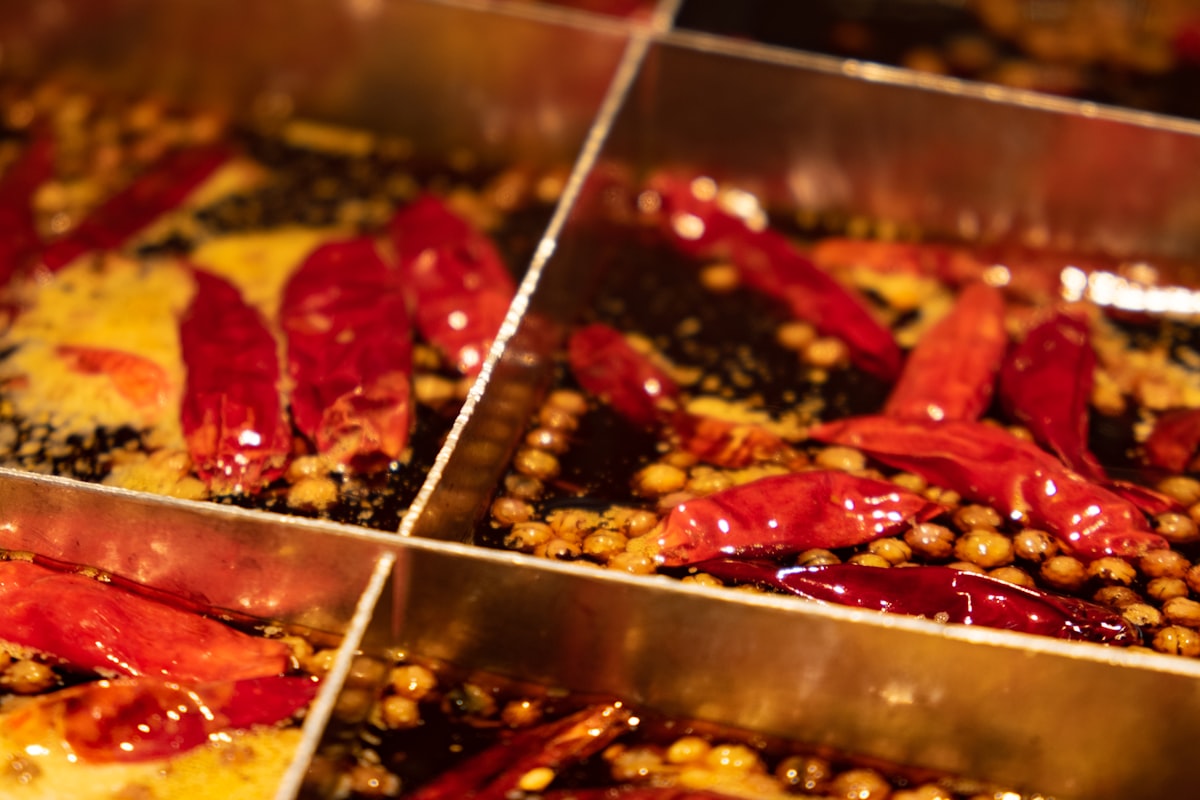
The broth is nearly solid chili oil. Unfiltered. Unapologetic. Floating with whole dried chilies, peppercorns, star anise, cassia bark, and enough chili oil to make the surface shimmer red-black. There is no “broth” in the Western sense — you are cooking in flavored oil.
Locals eat more hot pot when the weather is hotter. A 40°C (104°F) Chongqing summer day means hot pot for dinner. The logic: eating hot food makes you sweat, sweating cools you down. The beer helps too.
Spice Levels Explained
You must learn one phrase: wēi wēi là (微微辣). This is the lowest spice level available, and it means “tiny tiny spicy.” It is still hotter than “hot” in most countries. Do not be a hero. Your first hot pot should be at this level. You can always go up next time. You cannot undo ordering te la.
| Level | Chinese | Pinyin | Meaning | Who Should Order |
|---|---|---|---|---|
| Wei wei la | 微微辣 | wēi wēi là | ”Tiny tiny spicy” | First-timers. Still hotter than “hot” in most countries. Start here. |
| Wei la | 微辣 | wēi là | ”Mild spicy” | Brave first-timers with proven spice tolerance. |
| Zhong la | 中辣 | zhōng là | ”Medium spicy” | You regularly eat Thai, Indian, or Mexican hot and finish the plate. |
| Te la | 特辣 | tè là | ”Extra spicy” | You have trained for this. Most foreigners should not order this. |
| Chao la | 超辣 | chāo là | ”Super spicy” | Locals only. Do not attempt. We are serious. |
How to Order Hot Pot — Step by Step
Step 1: Choose your pot type.
Say these words: “yuān yāng guō” (鸳鸯锅). This is the Mandarin duck pot — a divided pot with half spicy broth and half mild broth. The mild half is usually mushroom or tomato. The spicy half is… the spicy half. This is non-negotiable for first-timers. Even locals order it when someone in the group cannot handle full heat. It gives you an escape route.
Step 2: Order ingredients.
You will be handed a paper checklist or scan a QR code. Here is your shopping list:
| Must Order | Chinese | Description |
|---|---|---|
| Beef slices | 肥牛 (féi niú) | Thin-sliced, cooks in 10 seconds. Marbled with fat. The workhorse ingredient. |
| Lamb slices | 羊肉 (yáng ròu) | Same concept, slightly richer flavor. |
| Tripe | 毛肚 (máo dǔ) | The #1 Chongqing hot pot ingredient. Beef stomach, thin and frilly. Dip into the pot, swoosh through the broth for exactly 7 seconds, eat immediately. The texture is a snappy crunch. This is the ingredient Chongqing people judge a hot pot restaurant by. |
| Duck intestine | 鸭肠 (yā cháng) | Sounds scary. Tastes like chewy, savory noodles. Slightly springy. Locals order it by the plate. Try it once — if you hate it, you never have to order it again. |
| Tofu skin | 豆皮 (dòu pí) | Dried tofu sheets that rehydrate in the broth and absorb every drop of flavor. |
| Lotus root | 藕片 (ǒu piàn) | Crunchy, slightly sweet, refreshing contrast to all the oil. |
| Potato slices | 土豆片 (tǔ dòu piàn) | Classic. Cook until just tender, not mushy. |
| Sweet potato noodles | 粉条 (fěn tiáo) | Add at the very end. They soak up the concentrated broth and become the final, richest bite of the meal. |
| Shrimp paste | 虾滑 (xiā huá) | Scooped into the pot in spoonfuls, cooks into tender shrimp balls. A modern favorite. |
Step 3: Make the dipping sauce. THIS IS THE SECRET.
Walk to the sauce bar. Every Chongqing hot pot restaurant has one — a counter with a dozen bowls of aromatics, oils, and pastes. Most foreigners do this wrong. They add more chili oil, more chili paste, more heat. This is like pouring gasoline on a house fire.
Your sauce is not your accelerator. It is your brake. Here is the formula that makes Chongqing hot pot survivable:
- Base: 70% sesame oil (香油, xiāng yóu). This is MANDATORY. Sesame oil coats the inside of your mouth and prevents capsaicin — the chemical that makes chili feel hot — from binding to your pain receptors. It is the single most important thing you will learn about eating Chongqing hot pot. Fill your sauce bowl mostly with sesame oil.
- + Minced garlic (蒜泥, suàn ní) — 1 to 2 generous spoonfuls. The garlic mellows in the sesame oil and adds depth.
- + Chopped cilantro (香菜, xiāng cài) — as much as you like.
- + A splash of black vinegar (醋, cù) — the acidity cuts through the fat.
- + A small amount of oyster sauce (蚝油, háo yóu) — for umami and slight sweetness.
- Optional: Chopped scallions (葱, cōng). A TINY amount of chopped chili if you genuinely want more heat (you do not, but the option is yours).
Do NOT add: More chili oil, dry chili powder, chili paste, or Sichuan peppercorn oil. The broth already contains enough heat to launch a rocket. Your sauce is your relief valve. Treat it that way.
When you pull an ingredient from the pot, dip it in your sesame oil sauce. Let it sit there for a second. The oil cools the food down and coats it in a protective layer. Then eat. This single technique is the difference between enjoying your meal and being in physical distress by the third bite.
Step 4: What to drink.
- Cold beer (重庆啤酒, Chóngqìng píjiǔ): The classic pairing. Chongqing Beer is the local lager — crisp, light, and somehow exactly what your mouth wants after a bite of málà. ¥8–15 per bottle.
- Soy milk (豆奶, dòu nǎi): Served warm or cold. The slight sweetness and creaminess soothe the burn. Locals swear by it. ¥5–8.
- Herbal tea (凉茶, liáng chá): Sweet, slightly medicinal bottled tea sold everywhere. ¥5–8.
- Sour plum drink (酸梅汤, suān méi tāng): Tangy, refreshing, excellent palate cleanser. ¥5–10.
Do NOT drink ice water. Cold water + hot chili oil in your stomach = a bad time. The cold contracts your stomach while the oil is sitting there. Warm tea or room-temperature soy milk is actually best.
Step 5: The after-effects are normal.
Your lips will tingle for about 20 minutes after the meal. Your mouth will feel fuzzy and slightly numb. Your stomach may gurgle. This is the Sichuan peppercorn (málà) doing what it does. It goes away. If your stomach is sensitive, take an antacid before the meal, not after.
Famous Hot Pot Restaurants
Chongqing has somewhere around 30,000 hot pot restaurants. Choosing one is overwhelming. Here are the ones that matter in 2026:
| Restaurant | Why Go | Price per Person |
|---|---|---|
| Pipa Yuan Shiweixian (枇杷园食味轩) | The world’s largest hot pot restaurant. 800+ tables cascading down a hillside on Nanshan mountain. Yangtze River views. Lanterns in the trees. It is a spectacle as much as a meal. Go at sunset. | ¥100–160 ($14–22) |
| Underground City Hotpot (地下城火锅) | Built inside a WWII air-raid shelter in Liangjiang New Area. 218 tables seating 1,300 people. Original rock walls, twinkling sky lanterns overhead. A YouTube video of this place hit 3 million views — it is wildly popular with international visitors. One of the most unique dining atmospheres in China. | ¥80–130 ($11–18) |
| Pei Jie Hotpot (珮姐火锅) | Celebrated its 10th anniversary in 2026. The mountainside branch in Nanbin Road has private rooms with views of the Yangtze River Cableway and Raffles City. Their secret-family-recipe broth includes laoying cha (eagle tea) for balance. Thick-cut tripe and vegetable-pork meatballs are the signature items. | ¥90–150 ($13–21) |
| Chunhong Hotpot (春红火锅) | Gritty, old-school, handwritten wooden plaques on the walls. Near Hongyadong. Fresh-cut local beef, slaughterhouse-fresh tripe, and goose intestines. Their waxberry shaved ice is the ultimate fire extinguisher after all that mala. | ¥70–110 ($10–15) |
| Cygnet Hotpot (小天鹅火锅) | Classic Chongqing brand with Jialing River views. Slightly more tourist-friendly, slightly less intense. A good transition hot pot for nervous first-timers. | ¥80–130 ($11–18) |
| Dezhuang (德庄) | Trusted local chain with consistent quality across dozens of locations. If you want reliable hot pot without the queue or the spectacle, this is your answer. | ¥60–100 ($8–14) |
| Zhou Shixiong Hotpot (周师兄火锅) | Clean, modern, famous for their “Big Knife Pork Loin” — thick-cut pork loin sliced tableside with a dramatic flourish. Good balance of quality and approachability. | ¥80–140 ($11–20) |
| Liu Yi Shou (刘一手) | Milder, slightly sweet broth. The best choice if you genuinely cannot handle spice but still want the hot pot experience. Multiple locations including Jiefangbei. | ¥35–60 ($5–8) |
| Haidilao (海底捞) | The international chain everyone knows. English menus, impeccable service, free manicures while you wait. Least intimidating option for nervous first-timers. Not the most authentic Chongqing experience, but a safe starting point. | ¥100–180 ($14–25) |
How to choose: If you want spectacle, do Pipa Yuan or Underground City. If you want authenticity, do Pei Jie or Chunhong. If you want safety, do Haidilao or Liu Yi Shou. If you are in a hurry and just want good hot pot, go to any Dezhuang and you will eat well.
Beyond Hot Pot — The Dishes You Need to Know
Hot pot is the headliner, but Chongqing’s food scene runs on these dishes too. Locals eat them between hot pot sessions — or instead of hot pot.
| Dish | Description | Price (¥) | Price ($) |
|---|---|---|---|
| Chongqing Xiaomian (小面) | THE breakfast noodle. Wheat noodles in a bowl of chili oil, Sichuan pepper, sesame paste, crushed peanuts, scallions, and a splash of black vinegar. Locals eat this at 7 AM standing at street stalls. The sauce at the bottom is the prize — mix everything thoroughly before your first bite. | ¥8–15 | $1–2 |
| Suan La Fen (酸辣粉) | Sour-spicy sweet potato noodles. Wide, translucent, slippery noodles in a tangy, numbing broth with pickled vegetables, crushed peanuts, and chili oil. The sourness from black vinegar balances the heat. Addictive. | ¥10–15 | $1.50–2 |
| Chuan Chuan Xiang (串串香) | Skewer hot pot lite. Individual bamboo skewers loaded with meat, vegetables, or tofu, dunked into boiling broth at your table. You pay by counting the empty sticks at the end (¥0.50–2 per skewer). More casual and cheaper than full hot pot. | ¥0.50–2/skewer | $0.07–0.30 |
| Shaokao (烧烤) | Night market grilled skewers — the Chongqing late-night food. Beef, lamb, squid, tofu, whole fish, eggplant, all grilled over charcoal and dusted with cumin, chili flakes, and salt. The smoke and the sizzle are part of the experience. Best eaten at plastic tables on the sidewalk after 9 PM. | ¥1–5/skewer | $0.15–0.70 |
| Bingfen (冰粉) | Ice jelly — the dessert you need after hot pot. A translucent, trembling jelly made from the seeds of the Nicandra plant, served in a bowl with brown sugar syrup, hawthorn flakes, raisins, crushed peanuts, and sesame seeds. Cold, sweet, slightly tangy. Locals call it the “fire extinguisher” (灭火器). | ¥5–10 | $0.70–1.50 |
| Ma La Tang (麻辣烫) | Individual hot pot in a bowl. You pick your ingredients from a display case, they cook them in the spicy broth, and serve everything together in a single bowl. No sharing, no communal pot, no cooking your own food. The solo diner’s hot pot solution. | ¥15–30 | $2–4 |
The Non-Spicy Chongqing — Food Nobody Tells Tourists About
Here is the thing about Chongqing: if you eat hot pot, xiaomian, and suan la fen for three meals in a row, your digestive system will mutiny. Locals know this. They do not eat málà all day every day. They alternate with an entire parallel food tradition that is mild, comforting, and almost completely unknown to tourists.
These are the dishes Chongqing families eat at home:
| Dish | Description | Price (¥) |
|---|---|---|
| Fenzheng Paigu (粉蒸排骨) | Steamed pork ribs coated in seasoned rice flour. Zero spice. The steaming renders the ribs tender and the rice flour becomes a soft, savory crust. Rich, aromatic, deeply comforting. A classic home-cooked dish. | ¥25–40 |
| Shaobai (烧白) | Braised pork belly, Chongqing style. Thick slices of pork belly are slow-cooked until the fat becomes translucent and the meat collapses under chopsticks. Caramelized, savory-sweet, melt-in-your-mouth. The Chongqing sister dish to Cantonese dongpo rou. | ¥25–40 |
| Youcha (油茶) | Savory crispy rice porridge. Puffed rice is crushed into a warm, thick rice paste, topped with crispy fried dough pieces, pickled vegetables, crushed peanuts, and a drizzle of chili oil (optional — it is mild without). A traditional breakfast that almost no tourist ever tries. | ¥8–12 |
| Douhua Rice (豆花饭) | Silken tofu over white rice. Simple. Clean. A local palate reset. The tofu is freshly made, still warm, and so soft it barely holds its shape. Served with a small dish of dipping sauce on the side (you control the heat). | ¥8–15 |
| Shancheng Tangyuan (山城汤圆) | Sweet glutinous rice balls filled with black sesame or peanut paste, floating in warm, sweet soup. The Chongqing winter dessert. Soft, chewy, the filling oozes out when you bite through the wrapper. | ¥10–15 |
| Xiao Surou (小酥肉) | Deep-fried pork tenders seasoned with cumin and Sichuan pepper (mild amount). Crispy on the outside, juicy inside. Eaten as a snack or appetizer. The street version is served in a paper cone and eaten while walking. | ¥15–25 |
| Dustpan Cake / Yundou Gao (熨斗糕) | Toasted rice flour pancakes shaped like old-fashioned irons (hence the name). Crispy golden outside, soft and slightly sweet inside. A disappearing street snack — find them at old-school breakfast stalls in residential neighborhoods. | ¥3–5 |
Why this matters: Alternate spicy meals with these. Hot pot for dinner → douhua rice for lunch the next day. Xiaomian for breakfast → fenzheng paigu and shaobai for dinner. Your stomach will thank you, and you will experience a side of Chongqing food that 95% of foreign visitors never discover.
Where to Eat — The Real Neighborhoods
Not all food streets are created equal. Some are where locals actually eat. Some are where tourists take photos of other tourists eating.
| Area | What | Best Time | Verdict |
|---|---|---|---|
| Guanyinqiao (观音桥) | WHERE LOCALS EAT. The food street (观音桥好吃街) is divided into Area A and B, packed with street stalls selling BBQ skewers (from ¥2), suan la fen (¥10), crispy pork belly, grilled octopus, crinkle-cut potatoes, stinky tofu, and handmade glutinous rice cakes. Follow the small queues of locals. The 9 Street (九街) section is the nightlife hub — bars, street performances, and shaokao joints still packed at 2 AM. | Lunch through late night | Go. This is the real deal. Less touristy than Jiefangbei, more authentic. Metro Line 3 or 9 to Guanyinqiao Station. |
| Jiefangbei / Bayi Road (解放碑/八一路) | The tourist food street. Comprehensive in that you will find every Chongqing dish represented. Clean, neon-lit, English signs. But prices are 20–40% higher than Guanyinqiao, and the food is catered to tourist palates — the spice levels are toned down, the flavors are safer. | Afternoon | OK for a first look. Walk through once to get oriented, then go to Guanyinqiao for the real meals. |
| Nanbin Road (南滨路) | Riverside BBQ and sit-down restaurants with Yangtze River skyline views. The Raffles City complex glows across the water at night. Grilled fish, skewers, and beer on terraces overlooking the river. | Evening | Go for dinner with a view. More upscale than street food. Good for a night when you want to sit down and be served. |
| Nanshan (南山) | The mountain south of the city center. Home to Pipa Yuan (the world’s largest hot pot restaurant) and other hillside hot pot spots. Fresh mountain air and a panoramic city view make everything taste better. | Evening | Go for the hot pot spectacle. The mountain restaurants are a destination in themselves. Taxi or DiDi required to get up there. |
| Ciqikou (磁器口) | Ancient riverside town turned tourist attraction. The main street is a souvenir gauntlet. BUT — the side alleys have good má là tàng shops, xiaomian stalls, and snacks that are better than the main drag. | Lunch if in the area | Skip the main street, explore the alleys. Worth a meal if you are already visiting Ciqikou for the history. |
| Shibati (十八梯) | Restored old Chongqing stairway neighborhood near Jiefangbei. Atmospheric with some decent noodle shops tucked into the stair-stepped alleys. More for the setting than the food itself, but a good place for a casual bowl. | Lunch or afternoon | Worth a walk-through. Combine with Jiefangbei sightseeing. |
| Danzishi Old Street (弹子石老街) | Revitalized historic street on the south bank. A few authentic hot pot and chuan chuan spots that locals recommend as alternatives to the Jiefangbei crowds. | Evening | An emerging food area. Less known, less crowded, worth exploring if you have an extra evening. |
Chongqing Breakfast — The Morning Ritual
Breakfast in Chongqing is savory, spicy, and fast. Locals eat standing up at street stalls, hunched over steaming bowls, chopsticks moving fast. The window is narrow — the best stalls sell out by 9 AM.
| Dish | Chinese | What It Is | Price (¥) |
|---|---|---|---|
| Xiaomian | 小面 | Spicy wheat noodles with sesame paste, chili oil, Sichuan pepper, peanuts, scallions. The classic. Every Chongqing person has a favorite stall, and they will argue about it. | ¥8–15 |
| Youcha | 油茶 | Savory crispy rice porridge with fried dough pieces, pickled vegetables, and peanuts. A dying tradition — fewer stalls serve it each year. Seek it out while it still exists. | ¥8–12 |
| Doufunao | 豆腐脑 | Soft tofu pudding. In Chongqing it is savory — topped with chili oil, soy sauce, crushed peanuts, and pickled vegetables. Do not expect the sweet Cantonese version. | ¥5–8 |
| Baozi | 包子 | Fluffy steamed buns filled with pork, vegetables, or red bean paste. The grab-and-go breakfast. | ¥2–3 each |
| Youtiao | 油条 | Golden fried dough sticks — crisp outside, airy and chewy inside. Dip in warm soy milk (豆浆, dòu jiāng) for the classic pairing. | ¥3–5 |
Where to go for breakfast: Any street near a residential area between 7 and 9 AM. Follow the steam. If you see a crowd of people in work clothes huddled around a counter, get in that crowd. The best stalls have no English, no sign, and a cook who has been making the same dish for 20 years.
Guanyinqiao has the densest concentration of morning food stalls. Jiefangbei has options but they skew more expensive and more tourist-oriented. The best xiaomian shops are small, neighborhood-specific, and fiercely defended by locals — ask a hotel front desk clerk where they eat breakfast, and go there.
How to Order Without Chinese
You can eat your way through Chongqing with zero Mandarin. The tools have gotten dramatically better.
QR code scan-to-order is nearly universal in Chongqing restaurants. Your table will have a QR code — scan it with Alipay or WeChat, and you will see a picture menu. Tap what you want, confirm, and food appears. This is the single biggest improvement for foreign diners in China in the last five years. In many mid-range restaurants, there is no physical menu at all — the QR code is the only way to order.
For street stalls and small shops with handwritten Chinese menus:
- Pull up Dianping (大众点评) on your phone and scroll the photo gallery — point at what looks good.
- Use Alipay’s built-in camera translation to decode Chinese characters in real time.
- Use Google Translate camera mode — screenshot the menu, feed it to the app.
For street stalls without any menu: Point at the ingredients, hold up the number of fingers for how many you want. Smile. It works.
Essential phrases:
| English | Chinese | Pinyin | When to Use |
|---|---|---|---|
| Tiny tiny spicy | 微微辣 | wēi wēi là | When ordering hot pot or noodles. Learn this one first. |
| Half spicy half mild pot | 鸳鸯锅 | yuān yāng guō | When ordering hot pot. Non-negotiable for first-timers. |
| I want this | 我要这个 | wǒ yào zhè ge | While pointing at a menu item or photo |
| One bowl | 一碗 | yī wǎn | For noodles and soups |
| One portion | 一份 | yī fèn | For shared dishes |
| No spicy | 不要辣 | bù yào là | When you need a break from chili oil |
| No cilantro | 不要香菜 | bù yào xiāng cài | If cilantro is not your thing |
| Very delicious! | 很好吃! | hěn hǎo chī | After you eat — vendors light up when you say this |
| Check please | 买单 | mǎi dān | When you are ready to pay |
| Thank you | 谢谢 | xiè xiè | Always |
Payment reality: Almost no street stall or small restaurant in Chongqing accepts foreign credit cards directly. You pay by scanning a QR code with Alipay or WeChat Pay. Set this up before you arrive — read our payment guide for the step-by-step. Key thing to know: Alipay’s foreign-card processing sometimes hits a ¥200 transaction threshold. If your bill exceeds ¥200, split it into two payments or ask the server to divide the charge.
Cost Expectations: What You Will Actually Spend
Chongqing is one of China’s best food value cities. You can eat like a king for what a single appetizer costs in New York.
| Level | Per Meal (¥) | Per Meal ($) | Examples |
|---|---|---|---|
| Street noodles (xiaomian) | ¥8–15 | $1–2 | A generous bowl of spicy noodles for breakfast |
| Street snack | ¥5–15 | $0.70–2 | Bingfen, youtiao, dustpan cake, a couple of shaokao skewers |
| Skewer meal (chuan chuan) | ¥30–60 | $4–8 | A full meal of skewers, counting sticks at the end |
| Casual hot pot | ¥60–100 | $8–14 | Local chain like Dezhuang, Liu Yi Shou |
| Famous hot pot restaurant | ¥80–160 | $11–22 | Pei Jie, Chunhong, Underground City, Pipa Yuan |
| Riverside dinner | ¥100–200 | $14–28 | Sit-down meal on Nanbin Road with river views |
| Full food day (all street food) | ¥60–90 | $8–13 | Breakfast + lunch + dinner + snacks, street stalls only |
| Full food day (restaurant meals) | ¥120–250 | $17–35 | Breakfast at a stall + sit-down lunch + famous hot pot dinner |
The bottom-line number: You can eat your way through Chongqing for $15–25 per day and eat extraordinarily well. A splurge day with a famous hot pot dinner, riverside lunch, and street breakfast runs about $30–40. This is absurd value.
Budget tips:
- Beer (Chongqing Beer or Tsingtao) is ¥5–15 at casual restaurants — way cheaper than wine or cocktails.
- Sour plum drink (酸梅汤) is ¥5–8 and pairs perfectly with spicy food. It is the cheapest and best beverage in the city.
- Tipping is not expected anywhere in Chongqing. Do not tip.
- Most restaurants do not add service charges. The price on the menu is the price you pay.
- Street stalls and casual restaurants almost never have English menus. Use the QR code or Dianping photo method described above.
Vegetarian and Dietary Needs
Vegetarian
Difficult but possible. Chongqing cuisine is built on meat and animal fat. The hot pot broth uses beef tallow. Xiaomian sauce contains minced pork. Suan la fen broth uses pork bone stock. The default state of almost every dish involves some animal product.
What you can do:
- Vegetarian hot pot: Order a mushroom or tomato broth separately — do NOT share a yuanyang pot if the spicy half uses beef tallow. Stick to tofu, tofu skin, mushrooms (especially enoki and shiitake), lotus root, potato, sweet potato noodles, and leafy greens. The dipping sauce bar is your friend — load up on sesame oil, garlic, cilantro, and vinegar.
- Buddhist vegetarian restaurants: Look for restaurants marked 素菜馆 (sù cài guǎn) or 斋 (zhāi). They exist near Buddhist temples — the Luohan Temple (罗汉寺) area in Yuzhong District has several. These are strict vegetarian — no animal products at all. ¥30–60 per person.
- Douhua rice (豆花饭): Plain silken tofu over rice. The dipping sauce on the side usually contains some chili oil but no meat. Ask for the sauce without pork mince: “不要肉末” (bù yào ròu mò).
- Bingfen (冰粉): The ice jelly dessert is vegan by default. Brown sugar, hawthorn, raisins, peanuts — no animal products.
The honest truth: Being vegetarian in Chongqing is harder than in Beijing or Shanghai. Plan ahead. Buddhist vegetarian restaurants are your safest bet for a full meal.
Gluten-Free
Extremely difficult. Soy sauce (which contains wheat) is the foundation of almost every savory dish. Wheat noodles are everywhere. Prepare a card with your restriction written clearly in Chinese:
“我对面筋过敏,不能吃小麦、大麦、黑麦、酱油、醋、面条、包子、饺子、面包。” (I am allergic to gluten — cannot eat wheat, barley, rye, soy sauce, vinegar, noodles, steamed buns, dumplings, bread.)
Hot pot ingredients (meats, vegetables, tofu, sweet potato noodles) are naturally gluten-free. The broth may or may not contain soy sauce — ask. Rice-based dishes like douhua rice are your safest option.
Halal
Possible with planning. There are Muslim Hui communities in Chongqing, primarily near Chaotianmen (朝天门) in Yuzhong District. Look for the green-and-white 清真 (qīng zhēn) sign — this is the official halal certification mark.
Where to look:
- The Chaotianmen area has several halal noodle shops and lamb restaurants serving the local Hui community.
- Lanzhou lamian (兰州拉面) shops are everywhere in Chongqing — these are halal by default (run by Hui Muslims from northwest China). Hand-pulled noodles in clear beef broth. Simple, satisfying, and reliably halal. ¥12–20.
- Halal hot pot restaurants exist but are uncommon. Most hot pot places use non-halal meat and the broth may contain alcohol (cooking wine).
Important: The Muslim food presence in Chongqing is much smaller than in Xi’an or Beijing. If you require strict halal, plan your meals in advance and do not rely on finding halal food spontaneously in every neighborhood.
Common Mistakes (And How to Avoid Them)
1. Not learning “wei wei la” before you arrive. This is the single most important phrase in Chongqing. The default spice level here would be classified as “extreme” in most Western countries. If you do not specify, you will get zhong la (medium) or higher by default. Order wei wei la on your first hot pot. You can always add heat. You cannot remove it.
2. Not making the sesame oil sauce properly. I have watched tourists at the sauce bar add extra chili oil, dry chili flakes, and Sichuan peppercorn powder to their dipping bowl. This is like ordering extra ghost peppers on a Carolina Reaper. Your sauce is your relief — 70% sesame oil minimum. The sesame oil physically coats your mouth and prevents the capsaicin from binding. This is chemistry, not preference.
3. Drinking ice water with hot pot. Cold water + hot chili oil in your stomach = discomfort. Warm tea, room-temperature soy milk, or beer. No ice.
4. Only eating at Jiefangbei / Bayi Road. Bayi Road is the tourist food street. It is fine for a first look — you will see every dish represented, the signs have English, and the environment is clean and accessible. But prices are inflated 20–40%, and the spice levels are toned down for tourist palates. Guanyinqiao (观音桥好吃街) is where locals actually eat. Go there for your real meals.
5. Eating hot pot every single meal. Your digestive system needs recovery time. The beef tallow, the chili oil, the Sichuan peppercorn — eating this three meals in a row is a recipe for spending a day in your hotel bathroom. Alternate spicy meals with non-spicy ones. Fenzheng paigu for lunch, hot pot for dinner. Douhua rice in the morning, chuan chuan at night. Pace yourself.
6. Not trying the street skewers at night. Shaokao (烧烤) — the charcoal-grilled skewers that appear on sidewalks after dark — is the best late-night food in Chongqing. The smoke, the sizzle, the cumin-heavy seasoning, the plastic tables spilling onto the sidewalk. This is Chongqing’s real nightlife. Go to Guanyinqiao’s 9 Street (九街) area or any residential neighborhood after 9 PM and follow the smell of charcoal.
7. Ordering xiaomian with no spice. You can do this. The cook will look at you like you ordered a steak well-done with ketchup, but they will make it. What you will get is a bowl of noodles in sesame paste and soy sauce — still tasty, but missing the point. If you truly cannot handle spice, order doufunao or baozi for breakfast instead. Or order xiaomian with wei wei la — the absolute minimum spice. It will be mild enough for almost anyone.
8. Not exploring the non-spicy side of Chongqing food. The biggest mistake tourists make is assuming Chongqing = spicy everything. The city has a deep, ancient non-málà culinary tradition — steamed pork ribs, braised pork belly, rice porridge, silken tofu — that locals eat regularly. These dishes are not on the tourist food street menus. Find them at sit-down restaurants in residential neighborhoods. They are worth seeking out.
9. Spending too much on a single restaurant. Chongqing food is cheap by design. The best xiaomian in the city costs ¥8–15. The best shaokao skewers are ¥1–3 each. A legendary hot pot meal runs ¥80–150 per person. If a “Chongqing food experience” tour or restaurant is charging ¥300+ per person, you are paying for the setting, not the food. The best food in Chongqing is served at plastic tables.
10. Not checking if a restaurant is open. Post-2025, some independent Chongqing restaurants have irregular hours or have moved. Check Dianping (大众点评) or a recent review before trekking across the city. This is especially true for smaller, family-run spots in residential neighborhoods.
The Bottom Line
Chongqing food is an extreme sport. The heat, the numbing, the intensity — it is designed to push you to the edge of what your mouth can handle. But the city also has gentler traditions that reward the curious eater: the steamed pork ribs, the silken tofu over rice, the warm glutinous rice balls, the crispy rice porridge that grandmothers still make for breakfast.
The formula is simple. Learn wei wei la. Make the sesame oil sauce — 70% sesame oil minimum. Alternate spicy with steamed. Eat xiaomian for breakfast at least once, standing at a street stall at 7 AM while the city wakes up around you. Follow the charcoal smoke at night. And when the hot pot leaves your lips tingling and your eyes watering and your chopsticks reaching for one more piece of tripe, know that this is exactly what is supposed to happen.
Chongqing has been feeding people for three thousand years — though the fiery spice tradition you taste today only took hold after chili peppers arrived from the Americas in the 16th century (a mere 400 years ago). You are in very good hands.