First-Timer's Xi'an: Terracotta Warriors, Ancient City Walls & 3-Day Itinerary (2026)

Xi’an was the capital of 13 dynasties, the eastern terminus of the Silk Road, and is home to what is widely considered the most significant archaeological discovery of the 20th century. It is also a food city of the highest order — one where the smells of cumin, lamb, and fresh flatbread pull you down side alleys you did not plan to walk down. Most travelers give it 2–3 days. This guide makes those days count.
Best Time to Visit Xi’an
Xi’an has two sweet spots and several windows you should avoid outright.
The two best windows
| Window | Avg Temp | Why Go |
|---|---|---|
| Mid-March to May (skip May 1–5) | 13–25°C (55–77°F) | Cherry blossoms on the city wall, comfortable walking, shoulder-season prices |
| Mid-September to late October (skip Oct 1–7) | 12–25°C (53–77°F) | Clear skies, golden light on the city wall, best photo conditions |
Spring and autumn both work. Autumn has slightly better light. Spring has fewer crowds outside the Labor Day window.
Windows to avoid
| Holiday | 2026 Dates | Impact |
|---|---|---|
| Labor Day | May 1–5 | High — 5-day domestic tourism surge, hotels spike, Warriors packed by 9:00 AM |
| National Day Golden Week | Oct 1–7 | Critical — avoid entirely. The Terracotta Warriors become shoulder-to-shoulder. Hotels double or triple. Train tickets vanish. |
| Chinese New Year | ~Feb 15–23 | Moderate — some businesses close, but Xi’an handles it better than most cities |
Season-by-season at a glance
| Season | Months | Verdict |
|---|---|---|
| Spring | Mar–May | Excellent — avoid early March (possible dust storms) and the Labor Day window |
| Summer | Jun–Aug | Hot — 35°C+ (95°F) and humid. The city wall is exposed with zero shade. Early mornings still work. |
| Autumn | Sep–Oct | Best overall — book well ahead, avoid Golden Week |
| Winter | Nov–Feb | Cold (−5°C / 23°F possible) but dramatically empty. Snow on the city wall is beautiful. Rock-bottom hotel prices. Avoid CNY window. |
How Many Days Do You Need?
| Days | What You Can Cover |
|---|---|
| 1 day | Terracotta Warriors only. You will leave feeling like you saw a parking lot and missed an entire city. |
| 2 days (minimum) | Warriors + City Wall + Muslim Quarter evening. Tight but covers the essentials. |
| 3 days (recommended) | Adds Shaanxi History Museum, Big Wild Goose Pagoda, Bell and Drum Towers, and breathing room. |
| 4+ days | Adds day trips (Huashan, Hanyangling Mausoleum), deeper food exploration, and a slower pace. |
A day trip from Beijing is technically possible — the 4-hour high-speed train puts you in Xi’an by late morning, and you can see the Warriors and fly back same night. Technically. It is also a 14-hour day, and you will be exhausted and resentful. Do not do it. Give Xi’an at least two nights.
Where to Stay in Xi’an
Xi’an has a compact historic core — the area inside the city wall is roughly 14 km² and walkable. Picking the right neighborhood matters less than in Beijing, but here is how the options compare.
| Area | Vibe | Price/Night | Best For | Trade-off |
|---|---|---|---|---|
| Bell Tower / Drum Tower area | Dead center, walk to Muslim Quarter and metro | ¥300–800 ($42–112) | First-timers, short stays, nightlife access | Can be loud until late — ask for a high floor |
| South Gate (Yongningmen) | Nicer hotels, closest to the city wall’s best entry, quieter | ¥400–1,200 ($56–168) | Couples, travelers who want a good hotel | 15–20 min walk to Muslim Quarter |
| Near Muslim Quarter | Budget guesthouses, maximum character, food at your doorstep | ¥150–400 ($21–56) | Solo travelers, food-first travelers, atmosphere | Noisy at night, basic rooms, alleys can be confusing |
| Qujiang New District | Modern, luxury, chain hotels, Big Wild Goose Pagoda nearby | ¥600–2,000+ ($84–280+) | Luxury travelers, families, business | Far from the old city — 30+ min metro to most sights |
Recommendation for first-timers: Stay near the Bell Tower. You step outside and you are in the middle of everything — the metro hub, the Muslim Quarter, the towers themselves lit up at night. South Gate is a close second if you want a quieter, slightly more polished experience.
Price note: Convert at approximately ¥1 RMB = $0.14 USD. A ¥400 room is about $56.
Getting to Xi’an
Xi’an sits at the geographic center of China’s high-speed rail network. It is one of the best-connected cities in the country.
By high-speed rail
| Route | Duration | 2nd Class Price | Notes |
|---|---|---|---|
| Beijing → Xi’an | 4–4.5 hrs | ~¥515 ($72) | 20+ trains daily. Depart Beijing West, arrive Xi’an North. |
| Shanghai → Xi’an | 6–6.5 hrs | ~¥670 ($94) | Fewer trains — book ahead. |
| Chengdu → Xi’an | 3.5 hrs | ¥263 ($36) | Excellent route — tunnel through the Qinling Mountains. |
| Luoyang → Xi’an | 1.5 hrs | ¥175 ($25) | Quick hop if you are doing a Henan-Shaanxi loop. |
Xi’an North Railway Station is 15 km north of the city wall. Metro Line 2 connects it to the Bell Tower in about 30 minutes. For everything you need to know about buying tickets, classes of service, and navigating Chinese train stations, read our China High-Speed Rail Guide.
By air
Xi’an Xianyang International Airport (XIY) is 40 km northwest of the city. Metro Line 14 connects to the city center in about 50 minutes. A DiDi to the Bell Tower costs roughly ¥120–150 ($17–21). Flights from Beijing take about 2 hours and typically cost ¥500–1,200 ($70–170) depending on how far ahead you book.
The 3-Day Xi’an Itinerary
This itinerary assumes you arrive the evening before Day 1. It is full but not frantic — each day has a clear anchor sight and room to breathe.
Day 1: Terracotta Warriors → Muslim Quarter Evening
This is the reason you came to Xi’an. Do it on Day 1 while your energy is highest.
Morning: Terracotta Warriors (3–4 hours on site)
Get there at 8:30 AM — when the gates open. By 10:00 AM the tour buses arrive and Pits 1 and 2 become a crush of selfie sticks and flag-waving guides. The difference between 8:30 AM and 10:30 AM is the difference between a contemplative, genuinely awe-inspiring experience and a theme-park queue.
How to get there:
| Option | Time | Cost | Best For |
|---|---|---|---|
| Metro Line 9 + Bus 613 | ~90 min | ~¥12 ($1.70) | Staying near city center, reliable, air-conditioned |
| Bus 306 (Tourist Bus 5) | 60–90 min | ¥8 ($1.10) | ⚠️ May be discontinued — recent reports say this line has been replaced. Use Metro Line 9 + Bus 613 instead. |
| DiDi / private car | ~50 min | ¥150–200 ($21–28) | Convenience, groups of 3–4 splitting cost, door-to-door |
The Metro route: Take Line 2 or Line 6 → Fangzhicheng Station → transfer to Line 9 (orange line) → Huaqingchi Station (Exit C) → Bus 613 direct to the museum entrance. This is now the most reliable option. If you are coming from Line 2, transfer to Line 1 at Beidajie first, then to Line 9 at Fangzhicheng.
If you take Bus 306, board the official green bus from the East Square of Xi’an Railway Station. Ignore anyone offering a “faster” or “express” private bus — they are not official and often include forced shopping stops. Note: Multiple recent sources report Bus 306 may have been discontinued — Metro Line 9 + Bus 613 is now the recommended route.
Visit order: Pit 2 → Pit 3 → Pit 1 (save the biggest for last). Pit 1 is the one you have seen in every photograph — 6,000 life-sized warriors in battle formation, each with a unique face. It is the main event. Pit 2 is smaller but has the most interesting archaeological detail — you can see half-excavated warriors still embedded in the earth. Pit 3 is the command center, compact and quick.
The ticket includes the Emperor Qinshihuang’s Mausoleum (Lishan Garden) — a free shuttle bus runs from the museum exit. It is a large earth mound with a small exhibition, interesting but not essential if you are short on time.
Full deep dive on the Warriors (history, interpretation, the emperor’s obsession with immortality) → see our Xi’an History Guide.
Evening: Muslim Quarter food crawl (2–3 hours)
Take the metro back to Bell Tower Station. Walk 10 minutes north into the Muslim Quarter. But — and this matters — do not stay on the main street (Beiyuanmen).
The Muslim Quarter is actually four interconnected streets:
| Street | What It Is |
|---|---|
| Beiyuanmen (北院门) | The main drag. Touristy, crowded, photogenic. Fine for a first walk-through. |
| Xiyang Shi (西羊市) | More authentic, more locals. Better food at better prices. |
| Dapi Yuan (大皮院) | Where the best yangrou paomo restaurants live. This is the street you came for. |
| Sajinqiao (洒金桥) | Breakfast street. Skip it in the evening. |
Turn off Beiyuanmen into Xiyang Shi or Dapi Yuan within 10 minutes. The food on the side alleys is noticeably better and costs about 30% less. For the complete food strategy — what to order, where to go, and how to eat yangrou paomo correctly — see our Xi’an Food Guide.
Brief must-tries tonight: roujiamo (肉夹馍, ¥12–18, crispy flatbread stuffed with cumin-spiced lamb or beef), yangrou paomo (羊肉泡馍, ¥35–50, lamb broth with hand-torn bread), and red-willow lamb skewers (¥10–15 for a handful, grilled over charcoal on fragrant willow branches).
Day 2: City Wall Morning → Shaanxi History Museum Afternoon → Big Wild Goose Pagoda at Dusk
Morning: City Wall bike ride (2–3 hours)
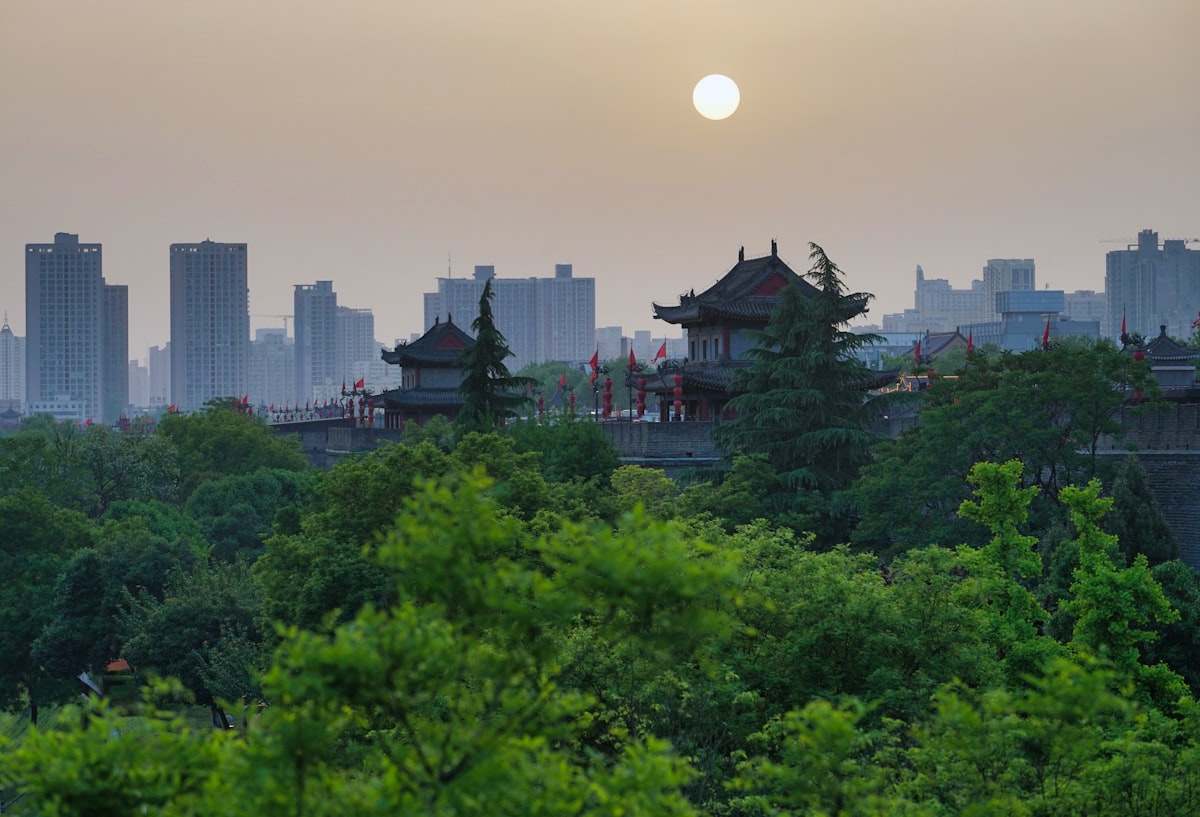
The Xi’an City Wall is the best-preserved ancient city wall in China — and one of the few you can cycle on top of. It is 13.7 km around, roughly a rectangle, and the top is wide enough to land a small plane.
| Item | Cost |
|---|---|
| Wall entry | ¥54 ($7.50) |
| Single bike rental (3 hrs) | ¥45 ($6.30) |
| Tandem bike rental (3 hrs) | ¥90 ($12.60) |
| Total per person (single bike) | ~¥99 ($13.80) |
Enter at the South Gate (Yongningmen) — it is the most impressive entry point, with a barbican gate, a drawbridge, and the full Ming Dynasty fortification on display. Rent a bike from the station just after the gate.
The full loop takes 1.5–2 hours at a relaxed pace with photo stops. The surface is uneven in places — ancient brick, not asphalt — so it is bumpier than you expect. Still, it is one of the most memorable bike rides you will ever do: the old city on one side, the modern skyline on the other, and the wide, car-free expanse of the wall stretching ahead.
Best time: Late afternoon for golden light and cooler temperatures. If you do it in the morning (as per this itinerary), start by 9:00 AM before the midday sun hits. There is almost no shade on the wall.
Bikes can be returned at any rental station around the wall — you do not have to complete the full loop if you are tired. South Gate rentals close at 10:00 PM; other gates close earlier (around 8:00 PM).
Afternoon: Shaanxi History Museum (2–3 hours)
This is one of China’s best museums — a collection that starts in the Zhou Dynasty (1046 BC) and runs through the Tang Dynasty golden age, all in a Tang-style building that is worth seeing in its own right. The Qin and Han galleries, the Tang gold and silver, and the mural gallery are exceptional.
Here is the catch: tickets are free, but they are among the hardest to get in China.
| Detail | Info |
|---|---|
| Cost | Free for the basic exhibition (Halls 1–3) |
| Reservation | Mandatory — no walk-up tickets exist |
| Platform | Official WeChat mini-program “陕西历史博物馆” |
| Release schedule | Tickets drop 5–6 days ahead at 17:00 (5:00 PM Beijing time) daily — not at multiple times |
| How fast they go | ~45 seconds |
| Closed | Every Monday (except national holidays) |
The backup strategy if free tickets sell out: Buy a paid special exhibition ticket. The Tang Dynasty Treasures exhibition (¥30 / $4.20) and the Tang Dynasty Murals exhibition (¥270 / $38) both grant access to all the basic halls too. The mural gallery is extraordinary if you care about art history — original Tang tomb murals transported and preserved in a climate-controlled hall.
Tips for getting tickets:
- Pre-fill all passport details in the WeChat mini-program at least a day before booking day.
- Set an alarm for 2 minutes before the drop time. Refresh at exactly the release time.
- If it shows “sold out,” keep refreshing for 10 minutes — unpaid reservations get released back into the pool.
- Check again the night before your visit (8:00–10:00 PM) — last-minute cancellations happen.
Evening: Big Wild Goose Pagoda + fountain show
Take Metro Line 3 or Line 4 to Dayanta Station. The Big Wild Goose Pagoda is a 7th-century brick pagoda built to house Buddhist scriptures brought from India. Entry to the temple grounds is ¥50 ($7). Climbing the pagoda itself costs an additional ¥30 ($4.20).
At dusk, the North Square hosts the largest musical fountain show in Asia — 1,000+ nozzles choreographed to orchestral music against the illuminated pagoda. Shows run every evening (usually 8:30 PM and 9:30 PM in summer, slightly earlier in winter). It is free, it is slightly cheesy, and it is completely worth seeing at least once.
Day 3: Bell Tower + Drum Tower → Great Mosque → Free Afternoon
Morning: Bell Tower and Drum Tower (1.5–2 hours)
These two landmarks sit in the geographic center of the old city, a few hundred meters apart. The Bell Tower marks the center of Xi’an — stand on the platform and every direction is an axis of the city’s ancient grid.
| Ticket | Cost |
|---|---|
| Bell Tower (single) | ¥30 ($4.20) |
| Drum Tower (single) | ¥30 ($4.20) |
| Combo ticket (both) | ¥50 ($7) |
Buy the combo ticket. See the Bell Tower first (it sits on a traffic island in the middle of a roundabout — enter via the underground walkway from the metro station). Inside is a small exhibition of ancient bells and a short musical performance. Then walk north to the Drum Tower — it faces the Muslim Quarter and has a better view north over the rooftops.
Late Morning: Great Mosque (45–60 minutes)
Hidden inside the Muslim Quarter, about a 5-minute walk from the Drum Tower, is one of the most interesting religious sites in China. The Great Mosque of Xi’an (¥25 / $3.50) is a 1,300-year-old mosque built entirely in Chinese temple architecture — pagoda-style minarets, courtyards with gardens, calligraphy in both Arabic and Chinese. It is a working mosque, so dress respectfully (shoulders and knees covered). It is peaceful in a way the surrounding streets are not, and even during peak season it is rarely crowded.
Afternoon: Your choice
Three good options for your remaining afternoon:
- Hutong wandering: The small streets and alleys south of the Bell Tower, around Shuyuanmen Street, are filled with calligraphy shops, ink-stone vendors, and tea houses. Walk south from the Bell Tower toward the South Gate through this area — it is tourist-friendly but more relaxed than the Muslim Quarter.
- Tang Paradise (大唐芙蓉园): A Tang Dynasty-themed cultural park near Big Wild Goose Pagoda. It is expensive (¥120 / $17) and unapologetically artificial, but the nighttime shows with water, lights, and Tang Dynasty music are genuinely impressive. If you go, go in the evening.
- Hanyangling Mausoleum: The tomb of Emperor Jing of Han, about 20 km north of the city. Less famous than the Terracotta Warriors but arguably more intimate — you walk on glass floors directly above excavated burial pits with miniature terracotta figurines. Entry ¥70 ($9.80). A DiDi takes about 40 minutes.
Terracotta Warriors: Essential Info
This is the quick-reference section. For the full historical context, read the Xi’an History Guide.
| Detail | Info |
|---|---|
| Location | 40 km east of Xi’an city center, Lintong District |
| Entry fee | ¥120 peak ($17, Mar 16–Nov 15) / ¥100 off-peak ($14, Nov 16–Mar 15) |
| Opening hours | 8:30 AM – 6:30 PM peak (last entry 5:00 PM) / 8:30 AM – 6:00 PM off-peak (last entry 4:30 PM) |
| Booking | Mandatory. Online only — WeChat mini-program or Trip.com. No walk-up ticket windows. |
| Booking window | Up to 7 days ahead. During holidays, book 10+ days ahead. |
| Passport | Required. Your passport is your ticket — name and number must match the booking exactly. |
| Guide | Official guide ~¥90 for 1–5 people. Audio guide device ~¥30. |
| Photography | Allowed (no flash). No drones, no selfie sticks in some halls. |
The 8:30 AM strategy: Be at the gate when it opens. Enter Pit 2 first (smaller crowds, more detail), then Pit 3, then Pit 1. By the time you reach Pit 1 — the big one — the first wave of early visitors has moved on and the tour buses have not yet arrived. You get roughly a 30–40 minute window where Pit 1 is manageable even in peak season.
Avoid the “terracotta factory” tours: Many cheap Warriors “tours” sold through hotels or street agents include a mandatory stop at a “terracotta factory” or “terracotta workshop” — a shopping stop where guides earn commission. These add 2+ hours to your day and sell overpriced replica statues. Book your own transport and tickets independently.
City Wall: The Full Picture
The wall you see today was built in the Ming Dynasty (1370–1378), encasing the Tang Dynasty core. It is 12 meters high, 15–18 meters wide on top, and encircles 14 km² of the old city. The moat around it is still filled with water.
| Feature | Detail |
|---|---|
| Circumference | 13.7 km (8.5 miles) |
| Surface | Ancient brick, uneven in places — expect bumps |
| Bike rental stations | 9, spread around the wall |
| Walking time (full loop) | 3–4 hours |
| Cycling time (full loop) | 1.5–2 hours |
| Best gate | South Gate (Yongningmen) — most impressive architecture |
South Gate vs other gates: The South Gate is the only one with the full barbican-entrance complex intact. The East, West, and North gates are smaller and less dramatic. If you only see one gate up close, make it the South Gate.
Night cycling: South Gate rentals stay open until 8:00 PM (returns until 9:30–10:00 PM). Cycling at dusk, watching the city lights come on from 12 meters above the streets, is one of the best things you can do in Xi’an. The wall is lit with lanterns and floodlights after dark.
Shaanxi History Museum: What You Need to Know
This museum ranks alongside the National Museum in Beijing and the Shanghai Museum. Its strength is the Tang Dynasty — Xi’an (then Chang’an) was the largest city in the world during the Tang, with over 1 million residents, and the collection reflects that.
| Detail | Info |
|---|---|
| Cost | Free (basic exhibition) |
| Paid upgrades | Tang Dynasty Treasures ¥30 ($4.20) / Tang Dynasty Murals ¥270 ($38) |
| Reservation | Mandatory via WeChat mini-program, 5–7 days ahead |
| Closed | Mondays |
| Time needed | 2–3 hours (basic) / 3–4 hours (with paid exhibitions) |
| Location | Xiaozhai East Road, near Metro Line 2/3 Xiaozhai Station |
If you cannot get a ticket to the main museum, the Qin-Han Branch Gallery (秦汉馆) is an excellent backup — and since October 19, 2025, it requires no reservation at all (just bring your passport). Located about 40 km from the city center near Metro Line 14. The collection focuses on the Qin and Han dynasties and is well-curated. This is the single most important Xi’an update for 2026: while the main museum has slashed daily tickets from 14,000 to ~5,000 during renovation, the Qin-Han branch is free, walk-in, and largely undiscovered by foreign tourists.
Muslim Quarter: A Note
The Muslim Quarter (回民街, Huimin Street) is Xi’an’s most famous food destination and one of the few places in China where you can walk for a kilometer and eat something different every 50 meters. It has existed for over 1,000 years, serving the Hui Muslim community that traces its roots to Persian and Arab traders on the Silk Road.
Here is the thing: the main street (Beiyuanmen) is a tourist thoroughfare. Red lanterns, souvenir shops, candy stalls that all sell the same sesame brittle. It is fun for one walk-through. But the food that makes Xi’an famous is on the side streets — Dapi Yuan, Xiyang Shi, the unnamed alleys where a man has been working the same lamb-skewer grill since 1995.
Strategy: Walk Beiyuanmen for 10 minutes to soak in the atmosphere, then turn down any side alley heading west. Follow the smell of cumin and charcoal smoke. Eat standing up. Do not fill up on one dish — eat small portions at multiple stalls. Bring wet wipes.
For the full breakdown of what to eat, where to find it, and how to navigate the Muslim Quarter like a local, see our Xi’an Food Guide.
Getting Around Xi’an
Xi’an’s old city is compact enough to walk, but you will need transport to reach the Warriors and some outer sights.
Metro
| Detail | Info |
|---|---|
| Lines | 12 lines, 422 km of track |
| Fare | ¥2–9 ($0.28–1.26) depending on distance |
| English signage | Yes — stations, maps, and announcements are bilingual |
| Coverage | All major sights except the Warriors (Line 9 + bus transfer covers that) |
| Operating hours | ~6:00 AM–11:30 PM (varies by line) |
Key metro lines for visitors:
- Line 2: North-south spine. Connects Xi’an North Station → Bell Tower → Xiaozhai (History Museum).
- Line 1: East-west, useful for getting to Fangzhicheng (Line 9 transfer).
- Line 9: Connects to Huaqingchi Station, the jumping-off point for the Warriors.
- Line 3: Connects to Big Wild Goose Pagoda (Dayanta Station).
- Line 4: Also serves Big Wild Goose Pagoda and Xi’an Railway Station.
How to pay: Alipay’s Transport QR code is the most foreigner-friendly option. Set your Alipay location to Xi’an, find the Transport module, and scan at metro gates. For the full setup guide, see our China Mobile Payment Guide.
DiDi
DiDi (accessed through the Alipay app in English) is reliable and cheap in Xi’an. Most cross-city trips cost ¥20–50 ($2.80–7). Drivers rarely speak English — have your destination in Chinese characters and let the app handle the rest. DiDi solves the language barrier and eliminates the need for cash.
Walking
Inside the city wall, distances look small on a map but are bigger than you think. The walk from the Bell Tower to the South Gate is about 20 minutes. From the South Gate to the East Gate is 40 minutes. Use the metro for anything over 2 km. Wear shoes you have broken in.
Navigation
Amap (高德地图, Gaode) is the most accurate map in China. Google Maps is unreliable for walking directions and public transit within the country. Apple Maps works in China and is a decent backup. For more on this, see our China Digital Survival Guide.
Common Mistakes First-Timers Make
1. Not booking the Terracotta Warriors in advance
There are no walk-up ticket windows. Everything is online, and during peak periods (especially Golden Week, Labor Day, and summer holidays) tickets can sell out. Book at least 7 days ahead — earlier during holidays. Set a calendar reminder.
2. Going to the Warriors at 10:00 AM
This is when every tour bus in Xi’an arrives simultaneously. The experience at 8:30 AM versus 10:30 AM is not the same attraction. Go early.
3. Booking a cheap “Warriors tour” that includes a factory shopping stop
If a tour price looks too good to be true, it includes a mandatory stop at a “terracotta factory” where guides earn commission on overpriced statues. These stops eat 2+ hours of your day. Book transport and tickets independently.
4. Trying to do Xi’an as a day trip from Beijing
The 4-hour high-speed train makes this seem possible. You arrive at Xi’an North by late morning, take the metro to the Warriors (another 90 minutes), see them, and rush back for an evening train. It is a 14–16 hour day. You will be exhausted and resentful. Give Xi’an at least one night, ideally two.
5. Skipping the Shaanxi History Museum because you did not know to book ahead
The museum is free and exceptional — and its tickets are among the hardest to get in China. If you did not pre-book 5–7 days ahead, you will not get in. The paid Tang Dynasty Murals ticket (¥270) is your backup.
6. Thinking the Muslim Quarter is just one street
Beiyuanmen (the main drag) is the tourist version. The real food is on Dapi Yuan (大皮院) and Xiyang Shi (西羊市). Turn off the main street within 10 minutes.
7. Not carrying your passport
Your passport is required for entry to the Terracotta Warriors (it is your ticket), for hotel check-in, and for Shaanxi History Museum entry. A photo on your phone is not enough. Carry the physical passport.
8. Visiting during Golden Week (October 1–7)
This is the busiest travel week in China. Every attraction is packed. Hotels double or triple in price. Train tickets vanish within seconds of release. If your dates are flexible, shift your trip by one week — the difference is night and day.
Quick Reference: Attraction Prices at a Glance
| Attraction | Entry Fee | ~USD | Booking Required? | Closed |
|---|---|---|---|---|
| Terracotta Warriors (peak) | ¥120 | $17 | Yes, 7+ days ahead | — |
| Terracotta Warriors (off-peak) | ¥100 | $14 | Yes, 7+ days ahead | — |
| City Wall | ¥54 | $7.50 | Recommended (online only) | — |
| City Wall bike rental (single) | ¥45 | $6.30 | No | — |
| Shaanxi History Museum | Free | $0 | Yes, 5–7 days ahead | Mondays |
| Tang Dynasty Murals (museum add-on) | ¥270 | $38 | Same as museum | Mondays |
| Bell Tower + Drum Tower (combo) | ¥50 | $7 | No (buy at gate or online) | — |
| Great Mosque | ¥25 | $3.50 | No | During prayer times |
| Big Wild Goose Pagoda (temple grounds) | ¥50 | $7 | No | — |
| Big Wild Goose Pagoda (climb) | +¥30 | +$4.20 | No | — |
| Tang Paradise | ¥120 | $17 | Recommended | — |
| Bell Tower (single) | ¥30 | $4.20 | No | — |
Xi’an-Specific Digital Tips
China’s app ecosystem applies here as everywhere. The specific Xi’an considerations:
| Tool | Why You Need It in Xi’an |
|---|---|
| Alipay | Metro QR, DiDi, food stalls in Muslim Quarter, Warriors ticket payment |
| Shaanxi History Museum mini-program, Warriors official account, general communication | |
| Trip.com | Warriors tickets (English interface, accepts foreign cards), train booking |
| Amap (Gaode) | Accurate walking directions inside the wall, metro routing, DiDi integration |
| A VPN | Install and test before you leave home |
For complete setup instructions, read our China Digital Survival Guide and China Mobile Payment Guide.
Bottom Line
Xi’an delivers what every traveler wants: one truly exceptional sight (the Warriors), an old city that is photogenic in every direction, and food worth planning an entire evening around. Two days covers the essentials. Three days is right. Four days lets you slow down and add a day trip.
Book the Warriors 7 days out. Get to the gate at 8:30 AM. Bike the wall at dusk. Eat roujiamo standing up on a side alley in the Muslim Quarter. Do the setup work — the city rewards it.
Related guides you will need:
- China High-Speed Rail Guide — train classes, booking, station navigation
- China Mobile Payment Guide — Alipay and WeChat Pay setup
- China Digital Survival Guide — apps, VPN, SIM cards, maps
- Xi’an Food Guide — where and what to eat in the Muslim Quarter and beyond
- Xi’an History Guide — Terracotta Warriors deep dive, Silk Road context, dynastic history