China Spring Festival Travel Guide 2027: The World's Largest Migration, and How to Survive It

A German traveler I met in Chengdu told me he’d planned his China trip for late January 2027. “Three weeks,” he said. “Beijing, Xi’an, Chengdu, Guilin, Shanghai.” He had a spreadsheet. He’d researched the weather. He’d read about the food.
I asked if he knew what happens in China in late January.
He did not.
Spring Festival 2027 falls on January 28. His trip would land directly in the middle of Chunyun, the 40-day travel rush surrounding Chinese New Year. During Chunyun, the country makes over 3 billion passenger trips. Train tickets sell out in seconds. Hotels triple in price. Entire neighborhoods close their doors. His three-week, five-city spreadsheet was, in practical terms, impossible.
He ended up staying in Chengdu for the whole two weeks. He ate hot pot on New Year’s Eve, watched fireworks from a bridge, visited a temple fair, and told me afterward it was the best trip of his life. He also spent the first three days eating convenience-store noodles because nothing was open.
This guide is for people considering a China trip in January or February 2027. It tells you what actually happens during Spring Festival, which parts are genuinely wonderful, which parts will test your patience, and how to decide whether to go at all.
Spring Festival 2027: The dates that matter
Chinese New Year’s Day is January 28, 2027, which ushers in the Year of the Goat. The official public holiday typically spans 7 days, from January 27 (New Year’s Eve) through February 2 or 3 (Day 6 or 7). Here is the timeline you need to know:
| Period | Dates | What happens |
|---|---|---|
| Pre-festival rush | Jan 15–26 | Train tickets become nearly impossible. Migrant workers, students, and office staff travel home. Cities start emptying. |
| New Year’s Eve | Jan 27 | The most important family dinner of the year. Everything closes by late afternoon. |
| Day 1–3 | Jan 28–30 | Peak shutdown. Most businesses, restaurants, and shops closed. Streets quiet. Families stay home. |
| Day 4–7 | Jan 31–Feb 2 | Temple fairs open. Some restaurants reopen. Domestic tourism within cities picks up. |
| Return rush | Feb 3–25 | Reverse migration as people travel back to cities. Train tickets again scarce. |
The Chunyun travel rush officially runs about 40 days, from roughly January 15 through February 25. During this window, 3 billion passenger trips happen across China’s railway, highway, and air networks. To put that number in perspective: it is roughly the entire population of India moving three times over, compressed into five and a half weeks.
What Spring Festival actually means in modern China
Chinese New Year is not comparable to Western New Year celebrations. Western NYE is a party that lasts one night. Spring Festival is a nationwide shutdown of normal life that lasts at minimum three days and reshapes the country’s logistics for a month on either side.
The core ritual is simple: everyone goes home. Factory workers leave Guangdong and Zhejiang for villages in Sichuan, Henan, and Anhui. Office workers in Shanghai and Beijing fly back to their hometowns. University students fill every remaining train seat. The annual migration is a cultural obligation, not a choice. If you are Chinese and you have living parents, you go home for New Year. If you cannot get a train ticket, you buy a standing ticket. If you cannot afford a flight, you take a 30-hour bus. The pressure to return is absolute.
For foreign travelers, this ritual creates a reality that no guidebook sugarcoating can hide: you are traveling through a country that is simultaneously shutting down and in peak transit chaos.
The shutdown is the bigger issue. Not just tourist attractions, which mostly stay open, but the infrastructure of daily life: the noodle shop on the corner, the convenience store, the fruit vendor, the barber. These are family-run businesses. The family goes home for New Year. The locks go on the doors for anywhere from three days to two weeks.
The transit chaos is the other half. If you try to buy a high-speed train ticket during the 15 days before Spring Festival, you will almost certainly fail. Tickets are released 15 days before departure at a specific time (varies by station, often 8 AM or 2 PM Beijing time). They sell out within seconds, not minutes. The booking system is designed for speed: Chinese users have their payment and identity verification preloaded, and they click “buy” the instant the clock hits release time. A foreigner fumbling with a passport number in Trip.com is simply not fast enough.
I need to be clear about something: this is not a “make sure to book ahead” situation. This is a “you probably cannot book this train at all” situation for the busiest routes during the 3-4 days around New Year’s Eve. If your trip plan involves intercity travel between January 15 and February 5, you need to either book flights (more expensive but more available), hire a private driver (expensive but flexible), or redesign your plan to stay in one city.
The honest version: What is terrible and what is good
Most English-language travel content about Chinese New Year falls into one of two buckets. Bucket one: “Avoid China during CNY at all costs.” Bucket two: “Experience the magic of red lanterns and dragon dances!” Both are true in isolation. Neither captures the full picture.
Here is what is genuinely terrible:
Train tickets, as covered above. The booking system during Chunyun is the hardest it will ever be for a foreign traveler. If you are set on multi-city travel during this period, use flights. China’s domestic flight network is extensive and flights are easier to book than trains during peak season. They cost more but you will actually get a seat.
Restaurant availability from January 27 through January 30 is grim. In major cities, hotel restaurants, foreign fast-food chains (KFC, McDonald’s), and some mall food courts stay open. Independent restaurants, especially small local ones, almost all close. You will not starve, but you will eat a lot of mediocre meals for three days. This is not the trip for a street-food-focused itinerary unless you are in a city where temples and fairs keep food stalls running (Beijing, Chengdu).
Hotel prices in tourist cities spike hard. Sanya, a beach city on Hainan Island, is the most extreme example: rooms that normally cost ¥400 become ¥2,000 or more. Lijiang and Dali in Yunnan, Hangzhou’s West Lake area, and Harbin during Ice Festival season all see 2-4x price increases. Book as far ahead as possible, and expect to pay more than you would at any other time of year.
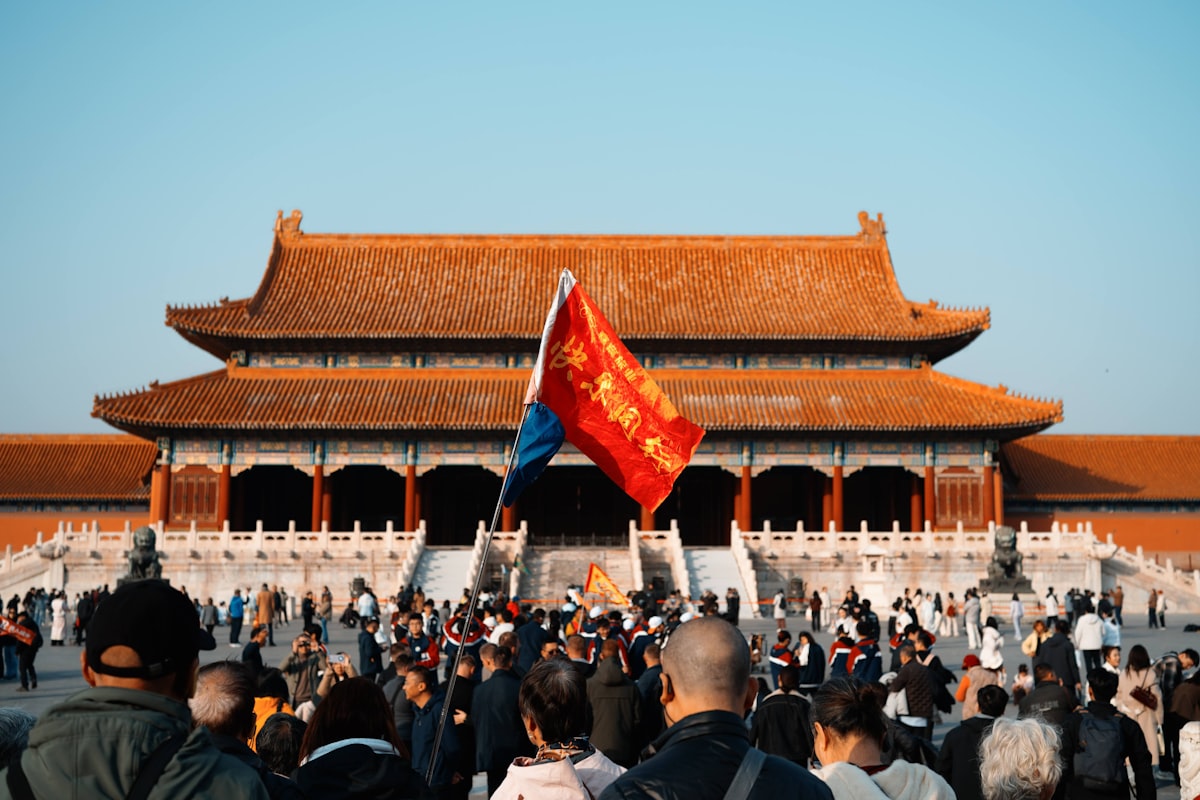
Attractions are packed during the afternoon holiday window (Days 4-7). The Forbidden City caps at 80,000 visitors per day and sells out well in advance. The Great Wall’s Badaling section becomes a slow-moving line of people. Temple fairs, which are the main cultural event, are shoulder-to-shoulder. If you hate crowds, you will hate this.
Here is what is genuinely good:
The temple fairs. Beijing’s temple fairs (Ditan, Longtan, Changdian) run from roughly Day 2 through Day 6 of the new year. They are loud, chaotic, and filled with folk performances, snack stalls, crafts, games, and thousands of families out for the holiday. For a foreign traveler, a temple fair is the single most concentrated dose of festival atmosphere you can find. Chengdu, Xi’an, and Nanjing all have their own versions. They are crowded. They are also the reason you came.
Fireworks, where they are permitted. Many large cities now restrict or ban fireworks for air quality reasons, but smaller cities, towns, and rural areas still put on enormous displays. On New Year’s Eve, the sky over much of China becomes a continuous rumble and flash. If you are in a place where fireworks are allowed, the midnight hour is genuinely spectacular. Rural homestays and smaller county seats are the best spots for this.
The quiet. Days 1 and 2 of the new year, especially the morning of New Year’s Day (January 28), are the quietest days of the year in China’s biggest cities. Streets that normally hum with traffic and commerce are empty. Shanghai’s French Concession, usually buzzing with delivery scooters and shoppers, becomes a ghost neighborhood. For certain travelers, this version of China is more interesting than the normal one.
The food. If you can find it, Spring Festival food is special. Dumpling-making on New Year’s Eve is a family ritual. Niangao (sticky rice cake) symbolizes rising prosperity. Whole fish, whole chicken, hot pot, and elaborate multi-course dinners define the holiday table. More on this below.
City-by-city: What Spring Festival looks like in different places
China is not one destination during Spring Festival. The experience varies dramatically by city.
Beijing
Beijing during Spring Festival is cold, crowded, and culturally the richest option. Daytime highs hover around 0 to 5 degrees Celsius (32-41 F). You will need a serious coat, gloves, and a hat. The reward is the temple fairs. Ditan Park hosts the largest, with traditional performances, folk arts, and snack alleys selling candied hawthorn sticks (bingtang hulu), fried dough twists, and lamb skewers. Longtan Park and Changdian are the other major fairs. Each has a slightly different character: Ditan leans traditional, Changdian is more arts-and-crafts, Longtan skews family-friendly.
The Forbidden City stays open through the holiday period but sells out. Book tickets online the moment they become available (check the official website about 7 days ahead). The Great Wall at Mutianyu, not Badaling, is the section to visit during the holiday: it handles crowds better and the winter snow on the wall and mountains is worth seeing. The Summer Palace freezes over partially, which makes for a different kind of visit: locals skate on Kunming Lake while tourists take photos of the ice.
Restaurants in tourist areas (Wangfujing, Nanluoguxiang) mostly stay open. Hutong neighborhoods empty out and many small shops close. Hotel breakfast is your friend on Days 1-3.
Shanghai
Shanghai during Spring Festival is the contrarian pick. The city empties out. Shanghai’s population includes millions of migrant workers and transplants from other provinces, and most of them go home for the holiday. The result: a city of 25 million that suddenly feels like a city of 8 million. The metro is calm. The streets are navigable. The Bund, which in normal times is thick with tour groups, has room to walk.
The tradeoff is that the city’s energy drains. Small restaurants in the French Concession close. Street vendors disappear. Some expat-friendly bars and cafes stay open, but much of the food scene shuts down for 3-5 days.
Shanghai’s CNY-specific attractions include the Yuyuan Garden Lantern Festival, which runs through the holiday period with elaborate lantern displays, and Longhua Temple, where incense-burning ceremonies draw large crowds of worshippers on New Year’s morning. If you want a temple experience without Beijing-level crowds, this is a solid option.
Shanghai is also a good base if you want to be in China during the holiday without having to fight the worst of the crowds. You trade cultural density for livability. Whether that trade is worth it depends on your tolerance for chaos.
Harbin
Harbin in late January is the coldest major city you will probably ever visit. Temperatures drop to -25 C or lower at night, and daytime highs struggle to reach -15 C. It is also, during Spring Festival, one of the most crowded tourist destinations in the country because the Harbin Ice and Snow Festival overlaps with the holiday. The ice sculptures at Ice and Snow World, the snow carvings on Sun Island, and the frozen Songhua River are at their peak condition in late January.
Spring Festival adds an extra layer to the Harbin experience: ice lanterns get red Spring Festival decorations, some venues add special performances, and the city’s Russian-influenced architecture (St. Sophia Cathedral, Central Street) looks best under snow and festival lights. The downside is that Harbin during the holiday is expensive and crowded. Hotels book up months ahead. Restaurants are busy. The ice slides at Ice and Snow World have lines that can exceed 90 minutes. Read our Harbin Ice Festival guide for the full survival strategy.
Chengdu and Chongqing
Sichuan and Chongqing during Spring Festival offer two advantages. First, the food culture is so central to daily life that more restaurants stay open than in other regions. Hot pot restaurants, in particular, often stay open through the holiday because hot pot is a social meal that fits the family-gathering mode of the season. Second, the weather is milder than Beijing or Harbin: Chengdu winter highs are around 10 C (50 F), gray but not punishing.
Chengdu’s temple fairs are smaller than Beijing’s but more food-focused. The Wuhou Shrine and Jinli Ancient Street host festival markets. The Panda Base stays open year-round and winter is actually one of the best times to visit: pandas are more active in cold weather and the crowds are thinner than in summer (Spring Festival week excepted). Sichuan opera tea houses, particularly in the Kuanzhai Alley area, put on special holiday performances.
Chongqing during Spring Festival is a spectacle of lights. The city’s hillside skyline, already dramatic in normal conditions, gets extra illumination for the holiday. The Hongyadong complex, a multi-level cliffside structure of restaurants and shops, is packed but looks like a floating lantern city at night. Hot pot in Chongqing during the holiday is a religious experience: families pack the big restaurants, mala broth boils on every table, and the city smells like Sichuan peppercorn for a week straight.
Yunnan (Kunming, Dali, Lijiang)
Yunnan is the escape hatch for Spring Festival. While the rest of China freezes or shuts down, Yunnan offers daytime temperatures of 15-20 C (59-68 F), blue skies, and a tourism infrastructure that stays open because domestic tourists flood the province during the holiday.
The catch is that Yunnan during Spring Festival is one of the most expensive places in China. Dali and Lijiang hotel prices can triple. The ancient towns are packed. The scenic spots (Erhai Lake, Jade Dragon Snow Mountain, Tiger Leaping Gorge) have queues. It is warm, it is beautiful, and you will share it with several million other people who had the same idea.
If you go to Yunnan during Spring Festival, consider staying in smaller towns near the main attractions rather than in the tourist centers themselves. Outside Dali old town, villages along Erhai Lake are quieter. Outside Lijiang, Baisha and Shuhe offer a scaled-down version of the experience with fewer tour buses. Kunming, the provincial capital, is less scenic than Dali or Lijiang but functions as a normal city during the holiday: malls stay open, restaurants serve, and hotel prices stay sane.
Our Yunnan Golden Route guide covers the full itinerary. During Spring Festival, pick one base in Yunnan and stay there. Do not attempt to hop between Kunming, Dali, and Lijiang during the holiday. The trains and buses will be fully booked.
Smaller cities and rural areas
This is where the real Spring Festival lives. In county seats and villages across China, the traditions survive in forms that have largely disappeared from big cities: elaborate ancestor worship ceremonies, unrestricted fireworks, homemade New Year foods passed down through generations, dragon and lion dances that go door to door through the village.
The problem for a foreign traveler is that these places are functionally inaccessible. There are no hotels that cater to foreigners. Nobody speaks English. Restaurants that exist for local residents are closed because those residents are at home cooking. You cannot simply “go to a village” for Spring Festival unless you have a Chinese friend who is taking you home with them.
If you do have a Chinese friend who invites you to their hometown for New Year, say yes. It will be the most authentic cultural experience available in China, and the logistical barriers (language, food, accommodation) vanish when you have a host family. If you do not have such an invitation, stay in a city.
Day by day: What to expect
January 27 (New Year’s Eve)
The most important evening of the year. Families gather for the reunion dinner (年夜饭, nian ye fan), a multi-course meal that is the centerpiece of the entire holiday. For a foreign traveler, this is the hardest day to eat out. Most restaurants close by mid-afternoon so staff can go home. Hotel restaurants are the reliable option. Some higher-end hotels host special New Year’s Eve dinners that are open to non-guests; book a seat a week ahead. After dinner, families watch the CCTV New Year’s Gala (春晚, Chunwan), a four-hour variety show that is the most-watched television broadcast on Earth. It is bizarre, campy, and a genuine cultural institution. Watch it in your hotel room with the English commentary on YouTube. The fireworks begin around midnight.
January 28 (New Year’s Day, Day 1)
The quietest day of the year. Streets are empty. Almost everything is closed. Families stay home, eat leftovers from the night before, visit close relatives, and give children red envelopes (红包, hongbao) filled with cash. For a traveler, this is a day to walk around and observe the silence. Parks are open. Streets are photographable in their emptiness. Eat at your hotel breakfast buffet, pack snacks for the day, and treat dinner as a scavenger hunt: find whichever restaurant is open and eat what they have. KFC and McDonald’s are the safety net.
January 29-30 (Days 2-3)
Married couples visit the wife’s family. Some small shops begin to reopen, particularly those run by older residents who do not travel far. Temple fairs begin on Day 2 in Beijing. In smaller cities, street performances (dragon dances, stilt walkers) appear in public squares. More restaurants reopen, though many remain closed through Day 3. Hotels with attached restaurants are still your most reliable meal source.
January 31-February 2 (Days 4-7)
Temple fairs are in full swing. Most restaurants have reopened by Day 5 or 6. Tourist attractions are busy with domestic visitors. The holiday officially ends on Day 7 (around February 2-3), but the return travel rush continues for weeks as migrant workers trickle back to coastal cities.
The food you should eat during Spring Festival
If you can find it, Spring Festival food tells the story of the holiday better than any temple fair.
Jiaozi (dumplings) are the northern New Year staple. Families make them together on New Year’s Eve, wrapping minced pork and cabbage into dough skins. The shape resembles ancient Chinese gold ingots, so eating them is a wish for wealth. If you are in Beijing, seek out a dumpling restaurant (饺子馆) that stays open during the holiday. If you are invited to a Chinese home on New Year’s Eve, you will almost certainly make and eat dumplings.
Niangao (年糕, “year cake”) is a sticky rice cake eaten in the south. The name is a homophone for “rising year by year,” so eating it is a wish for upward mobility. It comes in sweet and savory versions. Sweet niangao is fried with brown sugar. Savory niangao is stir-fried with pork and vegetables. Shanghai and southern cities are the places to find it.
Hot pot (火锅) is the holiday social meal. Families gather around a bubbling pot of broth and cook meat, vegetables, tofu, and noodles communally. During Spring Festival, hot pot restaurants are among the most likely to stay open, especially in Sichuan and Chongqing. The meal is inherently festive: shared, warm, and long. If you are traveling during the holiday and can find a hot pot restaurant that is open, eat there. It is the closest you will get to a Chinese family New Year meal as an outsider.
Whole fish (鱼, yu) appears on every New Year’s Eve table because the word sounds like “surplus.” The fish is served whole, head and tail intact, and the custom is to leave some uneaten to symbolize abundance carrying into the new year. Whole chicken symbolizes family unity. Spring rolls (春卷, chunjuan) represent wealth because they look like gold bars when fried.
Tangyuan (汤圆), glutinous rice balls in sweet soup, are eaten on the 15th day of the new year (Lantern Festival, which marks the official end of the holiday period). They symbolize family togetherness because the name sounds like “reunion.”
In practical terms, a foreign traveler during Spring Festival will eat hotel breakfast buffets, KFC, convenience store noodles, and whatever restaurant they can find that is open. The goal is to find at least one proper holiday meal: a temple fair snack binge, a hot pot dinner, or a hotel New Year’s Eve banquet. One good meal changes the entire experience.
Should you come? A decision tree
This is the question the whole guide has been building toward. Here is a framework for answering it.
Yes, come during Spring Festival if
- You want to see temple fairs, winter festivals, and a cultural event that has no Western equivalent
- You are okay with cold weather (Beijing, Harbin) or willing to pay a premium for warmth (Yunnan)
- You accept staying in one city and not attempting intercity train travel
- You are fine eating hotel food and fast food for three days
- Crowds at tourist sites during Days 4-7 do not bother you
No, do not come during Spring Festival if
- You want efficient logistics, multi-city itinerary, or spontaneous travel
- You want warm weather without paying triple hotel prices
- You want the “lively urban scenes” version of China (street life, night markets, restaurant hopping)
- You have limited patience for crowds, long queues, and things being sold out
- This is your first trip to China (there are better windows; read our first-timer guide)
Maybe, with the right strategy, if
- You stay in Shanghai: emptier than usual, more navigable, still has lantern festivals and temple events
- You go to Yunnan: mild weather, ethnic minority celebrations, but expect peak prices and crowds
- You pick one city and commit to it: the shutdown period is only 3-4 days, after which things reopen
- You come for the tail end (Days 5-15): the worst of the shutdown is over, temple fairs are still running, and travel logistics are starting to ease
A specific strategy that works: fly into a city on January 25 or 26, check into a good hotel, stock snacks and instant noodles in your room, use Days 1-3 as quiet exploration days, hit the temple fairs on Days 4-6, and fly out around February 3-4. You will see the cultural peak of the holiday. You will also eat some regrettable meals. The balance favors culture over comfort.
Practical survival tips
Booking strategy
Book hotels as far ahead as possible, ideally 2-3 months out for popular destinations. Use Trip.com or a Chinese booking platform (Meituan, in Chinese) for the best rates. Hotels with in-house restaurants are worth the extra cost: they become your food supply chain on Days 1-3.
For trains during the Chunyun window, your options ranked by reliability: flights (most reliable, most expensive), booking through a Chinese travel agent (can sometimes secure tickets foreigners cannot), Trip.com train booking (try it, know you will probably fail for popular routes), and private driver (¥800-1,500 per day, expensive but flexible). Our high-speed rail guide covers the booking system in detail.
For attraction tickets, especially the Forbidden City, book the moment they are released. The Forbidden City releases tickets 7 days ahead at 8 PM Beijing time on its official WeChat mini-program. The system requires a Chinese phone number for verification. If you do not have one, use Trip.com’s ticket service or ask your hotel concierge to book for you.
Food survival
Hotel restaurants are the strategy. When booking your hotel, check whether the property has at least one restaurant, confirm it stays open during Spring Festival, and plan to eat breakfast and one other meal there on Days 1-3. High-end Chinese hotels (not international chains) often put extra effort into holiday meals. A hotel New Year’s Eve dinner is worth booking even if you are not staying there; call ahead.
Stock your room. Before New Year’s Eve (January 27), go to a supermarket and buy: instant noodles, fruit, packaged snacks, bottled water, bread, peanut butter, whatever keeps. The convenience stores near your hotel may close. A room stockpile is the difference between mild inconvenience and actual hunger on New Year’s Day when you realize nothing within walking distance is open.
KFC, McDonald’s, and Pizza Hut stay open in most cities during the holiday. The food is the same as everywhere else, but they are open and they are warm. Starbucks typically stays open but with reduced hours. International hotel chains (Marriott, Hilton, Hyatt) keep their restaurants running. These are your safety net.
Language and greetings
Learn three phrases. They will make every interaction better.
新年快乐 (Xin nian kuai le, “shin nyen kwai luh”): Happy New Year. Use this everywhere.
恭喜发财 (Gong xi fa cai, “gong shee fah tsai”): Wishing you prosperity. More traditional, more formal. Use with older people, hotel staff, and anyone you want to show respect to.
过年好 (Guo nian hao, “gwor nyen how”): A simpler, northern-China-specific greeting meaning “have a good New Year.” Especially common in Beijing.
Do not say 红包拿来 (hong bao na lai, “give me a red envelope”). It is a joke phrase that children use with relatives. A foreigner saying it is funny exactly once, to exactly one person, who knows you well. In every other context it lands somewhere between awkward and rude.
What to wear
Beijing and northern China in late January are cold. Below-freezing cold. A heavy coat, insulated boots, thermal layers, gloves, and a hat are not optional. The temple fairs are outdoors and you will be standing in the cold for hours. Hand warmers (sold at convenience stores and pharmacies) are cheap and effective.
Shanghai and the Yangtze River Delta are damp-cold, around 0-8 C (32-46 F). The humidity makes it feel colder than the number suggests. A waterproof coat and layers are more useful than a single heavy parka.
Chengdu is gray and cool, around 5-10 C (41-50 F). Yunnan during the day is pleasant (15-20 C in Kunming) but cold at night (near freezing). Harbin requires a full cold-weather system: thermal base layer, fleece mid-layer, windproof outer layer, insulated boots rated to -30 C, face covering. Do not improvise Harbin clothing. Frostbite is real.
Internet and payments
Set up Alipay with your international card before you fly. During the holiday, cash is even less useful than usual: the small vendors who might take cash are closed, and the chain establishments that are open expect QR payment. Our mobile payment guide walks through the setup.
Install a VPN before departure. Install it at home, test it, confirm it works. You cannot download a VPN inside China. If you need WhatsApp to message family on New Year’s Eve, a working VPN is non-negotiable. Our digital survival guide covers the full connectivity setup.
Winter in China means your phone battery dies faster. Carry a power bank. Your phone runs your payment system, your map, your translator, and your VPN. Letting it die is not an inconvenience; it is a genuine problem.
Final word
Spring Festival is the hardest week of the year to travel in China. It is also the most culturally distinct week of the year to be there. The two facts are inseparable. The shutdown and the spectacle come from the same root: an entire country stopping normal life to gather with family.
If you come expecting efficient logistics and wide-open attractions, you will be miserable. If you come expecting chaos, cold, and the year’s best dumplings, you will probably leave with the same conclusion as the German traveler in Chengdu: it was the best trip of his life, and he ate a lot of convenience-store noodles.
Pick one city. Book early. Pack snacks. Learn to say Happy New Year. Keep your expectations realistic and your coat warm.
The full holiday calendar and strategies for every Chinese festival are in our holiday calendar survival guide. For the other major travel blackout week, read our Golden Week survival strategy in that same guide.
Related Guides
- First-Time China Travel Guide — Everything you need for a first trip: visas, payments, internet, and what to actually worry about
- China Holiday Calendar Survival Guide — All seven public holidays, ranked by severity, with survival strategies
- Harbin Ice Festival Guide — The world’s largest ice city, and how to survive -30 C
- China Digital Survival Guide — VPN, eSIM, and the app stack you need before you land
- China Mobile Payment Guide — Set up Alipay in ten minutes at home. This is the most important pre-trip task.