Harbin Ice Festival Guide 2026: The World's Largest Ice City, and How to Survive -30°C
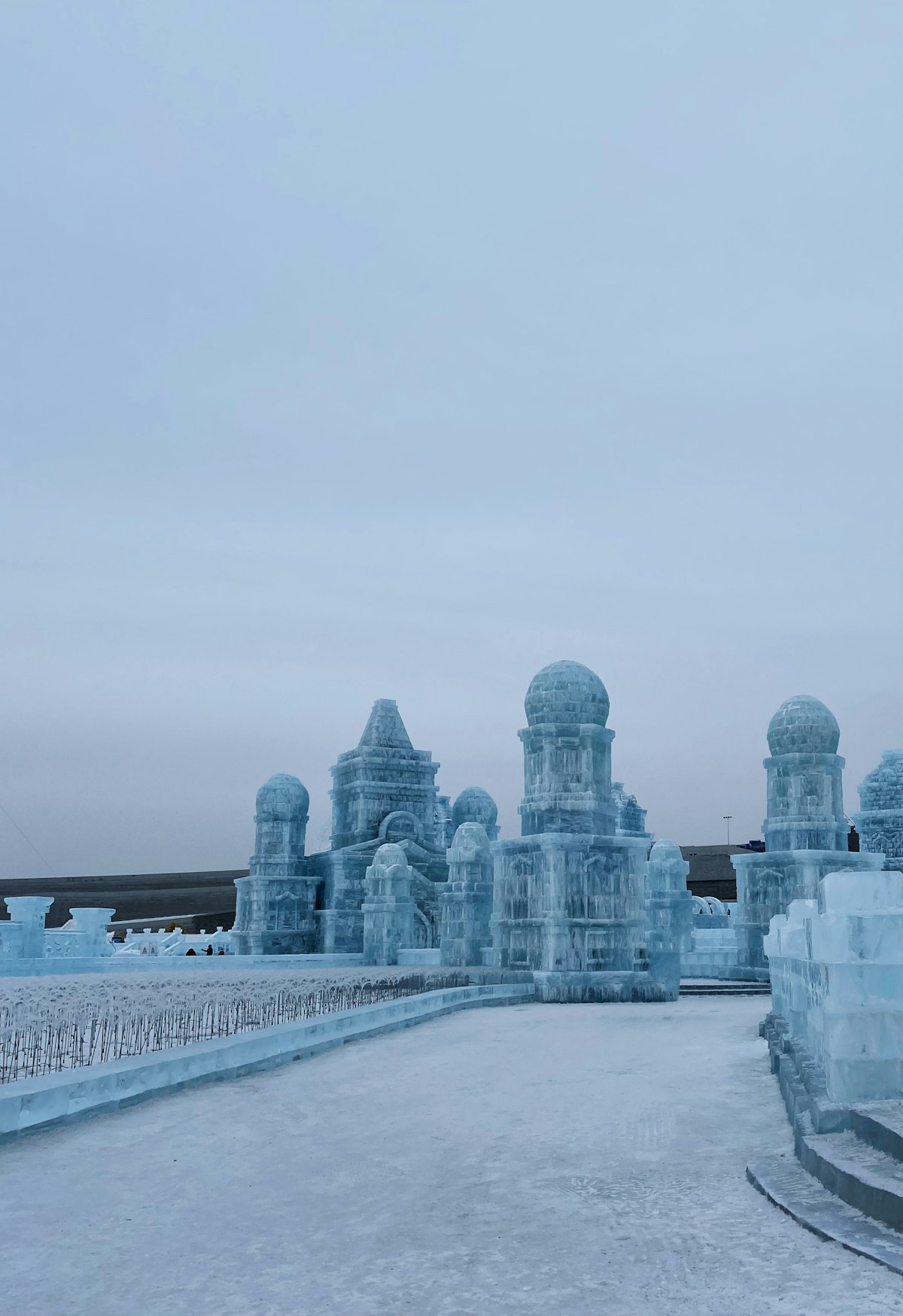
Most travelers to China head south: Shanghai, Beijing, Xi’an, the tropics of Yunnan. Harbin sits 1,000 kilometers north of Beijing, closer to Siberia than to Shanghai. In January, the temperature drops to -30°C. The Songhua River freezes solid enough to drive trucks on it. And every year, millions of Chinese tourists fly into this cold to stand in a theme park made entirely of ice.
The Harbin International Ice and Snow Festival is the largest winter festival on Earth. The main park, Ice and Snow World, takes up 1.2 million square meters. That’s roughly 170 soccer fields. The ice blocks — harvested from the frozen Songhua River — weigh 400,000 cubic meters. Workers cut, stack, carve, and illuminate them into a temporary city that glows blue, green, pink, and gold against the dark winter sky.
The festival runs from mid-December through late February. The official opening is January 5. If you time it right, you’ll see one of the most surreal landscapes on the planet. If you dress wrong, you’ll last 20 minutes.
This guide covers both parts: the magic and the survival.
Why Harbin Exists as an Ice City
Harbin is not an ancient Chinese city. It was a fishing village until 1898, when Russia began building the Chinese Eastern Railway through Manchuria. Harbin became a Russian railway town, and the architecture stuck. Walking down Central Street (Zhongyang Dajie) feels like wandering through early-20th-century St. Petersburg — cobblestones, baroque facades, cupolas, and spires. St. Sophia Cathedral, with its green onion dome, is the most photographed Russian Orthodox building in China.
The ice festival tradition started in 1963 as a local ice lantern garden party. It paused during the Cultural Revolution, resumed in 1985, and has grown every year since into the massive production it is now. In 2025-2026, Harbin saw over 80 million visitors during the winter season.
The festival sprawls across three main venues, plus the frozen river itself.
The Three Main Venues
Ice and Snow World (哈尔滨冰雪大世界)
This is the one you’ve seen photos of. Massive ice buildings — castles, palaces, temples, replicas of landmarks — built to scale, internally lit with LEDs, glowing in the dark like a frozen neon city. The tallest structures reach 40 meters. There are ice slides, an ice maze, an ice bar, and a Ferris wheel made of snow.
Entry costs ¥328 (about $45 USD) for a standard adult ticket. A VIP pass costs ¥800 and lets you skip the lines for the big slides and Ferris wheel.
This is the main event. You need about 4-5 hours here, and you should time your visit to see it both in daylight (when the ice looks like pale jade) and after dark (when the LEDs turn everything into a glowing fantasy). Arrive around 2:00 or 3:00 PM. You’ll catch the golden hour light on the ice, then the illumination switch-on around 4:30 PM (sunset comes early at this latitude).
The ice slides have lines that can exceed an hour. If that sounds terrible, the VIP ticket solves the problem. If you don’t buy VIP, go on the slides first thing when you arrive, before the evening crowds build.
There’s a heated indoor pavilion with KFC, Pizza Hut, and local food stalls. Duck into it every 30-45 minutes to thaw your extremities. Nobody is tough enough to stay outside for 5 hours straight in -25°C. The people who claim they are find out they aren’t.
Sun Island Snow Sculpture Expo (太阳岛雪博会)
Five kilometers across the river from Ice and Snow World, Sun Island is the daytime counterpart. Instead of ice, it’s snow — massive white sculptures carved by international teams, some the size of buildings. The snow carvings are more detailed than the ice ones because snow holds fine edges better. You’ll see animals, mythological figures, and architectural replicas rendered with a precision that seems impossible for frozen water.
Entry is ¥198. Go in the morning (the park opens at 8:00 AM), spend 2-3 hours, then cross back to Ice and Snow World for the afternoon-evening shift.
Sun Island’s sculptures read best in natural light. The all-white forms against blue sky make for better photographs than anything at Ice and Snow World, even if the scale is less overwhelming.
Zhaolin Park Ice Lantern Garden (兆麟公园冰灯游园会)
The original. Zhaolin Park, in the city center near Central Street, has hosted ice lanterns since 1963. The tradition began when local craftsmen carved ice blocks and put candles inside them. The modern version adds LEDs but keeps the intimate scale.
Zhaolin is smaller, cheaper (around ¥150, sometimes free), and less crowded than the big parks. The ice lanterns are traditional carved blocks with internal lighting, more like glowing sculptures than buildings. Live ice-carving competitions happen here throughout the season.
If you’re short on time, skip Zhaolin. If you have a third day and want something lower-key, it’s a pleasant evening walk.
The Songhua River
Between the venues and the city, the Songhua River freezes into a public playground. Ice skating, ice sailing, snowmobiles, horse-drawn sleighs, and the surreal sight of people swimming in holes cut through meter-thick ice (this is a local fitness tradition; do not attempt it). The river is free to access. Walk down, watch, take photos. The ice swimming happens most mornings.
When to Go
| Window | Crowds | Temperature | Verdict |
|---|---|---|---|
| Dec 17–31 | Low | -15 to -25°C | Soft opening. Most sculptures are done. Some kinks still being worked out. Good window. |
| Jan 5–15 | High | -20 to -30°C | Official opening period. Most crowded. Best sculptures are fresh. |
| Jan 16–31 | Medium | -20 to -35°C | The sweet spot. Post-opening crowds have thinned. Everything is fully operational. |
| Feb 1–15 | Extreme | -15 to -25°C | Chinese New Year. Avoid unless you want the holiday atmosphere specifically. |
| Feb 16–28 | Low | -10 to -20°C | End of season. Some sculptures may be partly melted. Warmer. Quieter. |
The best window for a foreign traveler is mid to late January. The sculptures are in peak condition, the crowds from the opening ceremony have dispersed, and you dodge Chinese New Year entirely.
Chinese New Year (Spring Festival) falls in January or February depending on the lunar calendar. In 2026, it’s February 15-23. The week of Spring Festival is the busiest period of Harbin’s entire year. Hotels triple in price. Ice and Snow World hits capacity. If your dates overlap with Chinese New Year, either skip Harbin or book everything 3+ months ahead.
How to Not Freeze
The cold in Harbin is not like cold in London or New York. It’s a dry, biting cold that finds every gap in your clothing. Exposed skin starts hurting in about 5 minutes at -25°C. Frostbite is a real risk on ears, nose, fingers, and toes.
The clothing system
| Layer | What to Wear | Why |
|---|---|---|
| Base: top and bottom | Merino wool or synthetic thermal | Wicks sweat. Cotton is useless — it stays wet and gets cold. |
| Mid | Fleece or wool sweater | Insulation. Down vests also work. |
| Outer (top) | Heavy down jacket rated to -20°C or below | The single most important item. Don’t cheap out. |
| Outer (bottom) | Insulated snow pants or thermal-lined trousers | Jeans are useless below -10°C. You need windproof. |
| Socks | Thin liner sock + thick wool outer sock | Two layers prevent blisters and trap more heat. |
| Boots | Insulated, waterproof, rated to -30°C | Thick soles insulate you from frozen ground. |
| Hands | Mittens over liner gloves | Mittens are warmer than gloves. Touchscreen-compatible liners let you use your phone. |
| Head | Hat covering ears + balaclava or face mask | Ears freeze first. A face covering is not optional below -20°C. |
| Extras | Adhesive heat packs (暖宝宝) | Stick them in your boots, gloves, and lower back. Buy at any convenience store in Harbin. ¥2-5 each. |
You can buy or rent extreme-cold gear in Harbin if you’d rather not invest in a -30°C wardrobe for one trip. The shopping streets near Central Street sell everything. But quality varies. A cheap “down” jacket from a street stall may be stuffed with polyester fill that does nothing below -15°C. If you buy, check the label.
What Else to Do in Harbin
The ice parks are the reason you came, but the city has other things worth your time.
Central Street (中央大街). A 1.4-kilometer pedestrian street of Russian and European buildings, now housing restaurants, bakeries, and souvenir shops. The cobblestones are original. The ice cream sold from street windows — eaten while walking in -20°C — is a local tradition. The cold means the ice cream doesn’t melt; it just gets thicker and creamier.
St. Sophia Cathedral (圣索菲亚教堂). Built in 1907, the largest Russian Orthodox church in East Asia. It’s now a museum of Harbin architecture, not an active church. The green dome against snow is the classic Harbin photo. Go at dusk when the floodlights hit the facade.
Siberian Tiger Park (东北虎林园). A conservation center for the critically endangered Siberian (Amur) tiger. Over 500 tigers live here in large enclosures. You ride a bus through the grounds while tigers walk up to the windows. It’s the closest most people will get to a wild apex predator. Some travelers find the experience uncomfortable — the tigers are well cared for but it’s still a zoo, not a safari. ¥110. Go in the morning when the tigers are active.
Unit 731 Museum (侵华日军第七三一部队罪证陈列馆). In the southern suburbs. During World War II, the Japanese army operated a biological warfare research unit here that conducted experiments on human subjects. The museum is harrowing and essential. It’s not for everyone. If you go, set aside 3 hours and prepare for a heavy day. Free entry.
Volga Manor (伏尔加庄园). A theme park of Russian architecture in the snow, about an hour outside the city. Ice slides, horse-drawn sleigh rides, a replica ice cathedral. It’s 100% manufactured and 100% photogenic. ¥160. Worth half a day if you want more winter scenery without the Ice and Snow World crowds.
What to Eat
Harbin’s food is shaped by its climate and its Russian history.
Guo Bao Rou (锅包肉). Crispy fried pork slices in a sweet-sour sauce. This is Harbin’s signature dish. Every restaurant makes it. The best versions shatter when you bite them.
Harbin Red Sausage (哈尔滨红肠). A smoked pork sausage with Russian origins, similar to kielbasa. Sold everywhere, eaten as street food or sliced into stir-fries. Buy some at Qiulin (秋林), the famous old food store on Central Street.
Dongbei Hot Pot (东北火锅). Northern-style hot pot with pickled cabbage (suan cai) and pork belly. Sour, rich, and restorative after hours in the cold.
Candied hawthorn skewers (冰糖葫芦). Hawthorn berries on a stick, dipped in hardened sugar. Sold warm from street carts. The contrast of hot sugar shell and tart frozen fruit is the taste of Harbin winter.
Kvass (格瓦斯). A fermented rye bread drink, lightly alcoholic, brought by Russian settlers. Tastes like liquid sourdough. Available in bottles everywhere. Try it once.
Russian food. Harbin has the best Russian restaurants in China. Tatoc (塔道斯), in a 1901 building on Central Street, serves borscht, pelmeni, and black bread in a dining room that hasn’t changed much in a century. Portions are large and prices are reasonable (¥100-200 per person for a full meal).
Logistics
Getting there
Harbin Taiping International Airport (HRB) has direct flights from Beijing (2 hours), Shanghai (3 hours), Guangzhou (4.5 hours), and international connections from Seoul, Tokyo, and Russian Far East cities. The airport is 37 kilometers from downtown. An airport shuttle bus costs ¥20 and takes about an hour. A Didi costs ¥120-150.
High-speed trains from Beijing take 5-7 hours. From Shenyang, about 2.5 hours. If you’re already in northeast China, the train is more pleasant than flying.
Where to stay
Stay in Daoli District, near Central Street. This puts you within walking distance of the cathedral, the river, and most restaurants. The Ice and Snow World is a 20-minute metro or Didi ride from here.
Budget hotels run ¥200-400 during non-holiday periods. Mid-range international chains (Holiday Inn, Ibis) are ¥400-700. The Shangri-La and Sofitel run ¥1,000-2,000 for those who want a heated pool to come back to.
Book early. Harbin’s winter hotel capacity fills completely during Spring Festival, and the best-located mid-range hotels book out even during normal weeks.
Getting around
Harbin Metro Line 2 connects Central Street (Shangyedaxue Station) to Ice and Snow World (Ice and Snow World Station) in about 20 minutes. The metro is warm, clean, and efficient. Use it whenever possible.
Taxis and Didi work but are less reliable in extreme cold — demand spikes at night when everyone tries to leave the ice parks simultaneously. If you leave Ice and Snow World after 9:00 PM, expect to wait for a ride. The metro is faster.
A 3-Day Itinerary
Day 1 — City. Arrive, settle in. Walk Central Street. See St. Sophia Cathedral lit up at dusk. Dinner at a Russian restaurant. Buy heat packs at a convenience store. Go to bed early.
Day 2 — Ice. Morning at Sun Island Snow Sculptures (arrive by 8:30 AM). Lunch break. Afternoon and evening at Ice and Snow World (arrive by 2:30 PM, stay until 8:00 or 9:00 PM). Eat KFC in the heated pavilion. This is a long, cold day. It’s also the reason you came.
Day 3 — Tigers and city. Siberian Tiger Park in the morning. Afternoon: revisit Central Street or add Zhaolin Park ice lanterns if you want more ice. If you have the stomach for it, the Unit 731 Museum takes half a day.
If you only have two days, drop Day 3. Ice and Snow World + Sun Island + Central Street is the essential Harbin experience.
Final Practical Tips
Batteries drain fast in extreme cold. Keep your phone in an inner pocket against your body. Carry a power bank. Your phone may shut down at 30% battery — this is normal; it’ll recover when warmed up.
Condensation kills cameras. When you go from -25°C outside into a warm building, moisture condenses on the lens and sensor. Before going indoors, seal your camera in a ziplock bag. Let it warm up for 30 minutes before opening.
Bring cash. Most places accept Alipay and WeChat Pay, but your phone dying means you need a backup. ¥300-500 covers an emergency taxi and hot meal.
Go to the bathroom before you go out. Public toilets in the ice parks are unheated. You do not want to disassemble four layers of clothing in a -20°C cubicle.
Harbin is not a foodie city in the tourist zones. The restaurants near Central Street and the ice parks serve adequate, filling, heavy food designed for cold weather. It’s not going to be the best meal of your China trip. The Russian restaurants are the exception.
Harbin in winter is extreme, exhausting, and unlike anywhere else on Earth. You will be colder than you have ever been. You will also stand in a glowing ice cathedral, breath steaming, surrounded by lights and frozen architecture and thousands of people who traveled across a continent to be exactly here, and you will understand why they came.